RSS

Category Archives: BlogNotes

Blogging about my adventures in woodworking. Yes, you will read it.

Turning mistakes into opportunities.

We’ve all done it; cut some piece in our project the wrong size, accidentally gouged it, or otherwise messed it up. Usually, we just move on to another piece, discarding that one.

Sometimes “mistakes” can actually be opportunities in disguise.

One example was Edison’s attempt to make a telegraphic-telephonic repeating and recording device, it didn’t work, but when somebody gave it a spin it sounded like human speech. Edison started from that chance observation and developed the phonograph.

It can also happen in the shop.

While developing my clock Keene, I turned would could have been a disaster into a chance to get really creative.

Take a look at this picture – especially the shot of the back of the clock:

craftsman clocks

Look at the sides of the door. You’ll see the back door, which is quilted maple, a thin sliver of Paduak, and then more maple. It’s a nice visual interest; otherwise, it would have been just plain maple on maple, up to the Paduak leg.

It wasn’t intended that way! Here’s the back-story:

I had to rabbet the sides of the clock to recive the back door. I did this on my router table. It was a 1/4” rabbett on a 1/2” stock. Of course, I set up and tested the rabbett on a scrap piece of stock. Worked fine. Right depth and so on. My mistake was, I did the whole depth in one pass on the real pieces. I should have done an 1/8” at a time, instead of the whole 1/4”. What ended up happening was, the bit crept out of the collet on the router, cutting deeper than I wanted. Ugh!

The only option was to throw out 4 nice pieces of maple ( I was making two clocks), or get creative.

What I ended up doing was re-rabbetting all four pieces to an equal depth, and then gluing in a strip of paduak to bring the rabbett back up to the originally intended 1/4” depth, to properly receive the door. The result was a more visually appealing ( I think) back of these pieces.

Obviously, sometimes mistakes can’t be fixed; if you needed a piece to be 8” long, and you cut it to 7”, you probably can’t just glue it back on and hope no one will notice. Some mistakes are final.

But other times, if you get creative, you can turn mistakes into a positive.
 
Leave a comment

Posted by on January 28, 2012 in BlogNotes


Tags:

Planning on Plans?

woodworking plansSo I’m considering selling my plans on line now. I’ve been asked for them several times. However, being the over-achiever perfectionist I am, I want to do it really well. Not just an exploded drawing with some measurements, but actual directions on what to make first, tricks for doing it right, and so on. I want the experience to be so good, the customer will come back.

It’s also worth pointing out that the time I put into a plan, which would be considerable, would generate residual sales for years. Compare that to building one clock, for instance, then selling it, building another, selling that one, and so on. Instead, I build once, sell many times, like authors or recording artists. I like that.

 
Leave a comment

Posted by on January 28, 2012 in BlogNotes


Local Artist Feature = lots of biz!

In November of 2010, I took a chance and submitted my name to the local newspaper here in Rochester, NY (third largest city in NYS), and they decided to go with me! I just answered some questions in an email they sent me, send a pic of myself, and a piece I would want them to feature in the article.

I got a TON of business from it. I had people calling from all over, wanting my clock, or throwing out other business proposals. I was literally getting a call every other day for an order. This lated about 10 days. Not only that, it was only about a month away from Christmas! I was in the shop working 14 hour days for a couple of weeks, which is dangerous, when you think about it, being tired around power tools, and such! Anyway, it was a great ride. Sadly, haven’t done as much business since. While it wasn’t an advertisement, per se, there’s no denying that print media had a big impact on my business. So, checking out the prices for a decent size, color, magazine and newspaper ad, I found them to be about $500! Yes, one ad in the newspaper – one day – was about $500 for a modest-size colored ad! Ads in targeted markets in magazines, such as Adirondack Life, or American Bungalow magazine were along the same lines. At least people generally keep magazines around for a while; newspapers, no.

Anyhow, here’s the blurb in the paper:

Craftsman article

 
Leave a comment

Posted by on January 24, 2012 in BlogNotes


Tags:

Craftsman, Mission, Arts and Crafts – Whats the difference?

People use the terms “Craftsman”, “Arts and Crafts” and “Mission” interchangeably to describe a popular style of the early 1900s; but what is the real difference amongst them? In this short article, I hope to spell out those distincitions.

arts and crafts chairArts and Crafts.

The Arts and Crafts style is the earliest of the three. This style began in England, Australia, America and Canada between 1880 and 1910 as a backlash response to the industrial revolution of the time. It was instigated in the 1860s by artist/write William Morris, who created the “Morris Chair” we still have with us today. The backlash was by artisans fighting back against “soul-less” mass-produced items from large factories. Also, it was a backlash against lavish ornamentation of the Victorian age. They were in favor of the master craftsman, who created all the parts of an item and assembled and finished it, with help from apprentices. This is in contrast to manufacturing plants, whose goal it was to turn out the most pieces possible.

The hallmarks of this movement was simplicity of form, to the point of exposed joinery, while emphasising the beauty of the material being used, primarily wood. They also brought in elements they found in British textiles that featured flora and fauna. Usually, they employed carvings, inlays, curvature and other ornamentation.

Machinery was not all together rejected by the craftsman; generally, they used it to lessen the mindless repetitive tasks at hand, such as sanding. Use of machines was generally kept to a minimum though.

In this photo, you can see the typyical hallmarks of an Arts and Crafts piece – the straight and curved lines, simpleness of form and intricate carving.

Mission ChairCraftsman.

In America, homes were built that tried to incorporate the stylings of the Arts and Crafts movement, with a modified interpretation, and it was called theCraftsman style; it is an American domestic architectural, interior design, and decorative arts style popular from the last years of the 19th century through the early years of the 20th century. The name comes from a popular magazine published in the early 1900s by furniture maker Gustav Stickley called The Craftsman. It was a great marketing term, as it evoked the image of the piece being made by hand by an artisian, which was exactly the case.

The design lines of the Craftsman style are generally thicker and larger than those of the Arts and Crafts style. Craftsman pieces typically did NOT use carving, inlay, curved boards, and other “decorations,” all of which Stickley was opposed to in his early years of production; however, Stickley’s designs evolved as well, and so it is hard to define a certain piece of furniture as “Stickley” over his 15-20 years of work, as it began to look more like Arts and Crafts in his later designs.

In this photo of a Morris Chair, you can see an example of the simple design, using straight lines and expose joinery with little embellishment that is so typical of the Craftsman movement.

Mission.

Mission styling is the same as Craftsman. But how did this happen? A salesman of Stickley’s was travelling around, trying to sell some items out of Stickley’s catalog. Interviewed by a reporter, this salesman stated that there was a table like “that one” (pointing to a drawing in the catalog) ,  in a “Spanish Mission in southern California.” The newspaper had printed the story with the word “Mission” in the heading and sidebar, and it stuck.

 
1 Comment

Posted by on January 24, 2012 in BlogNotes, The Craftsman Style


Tags: , ,

How the Sentinel Mission Pulpit was built.

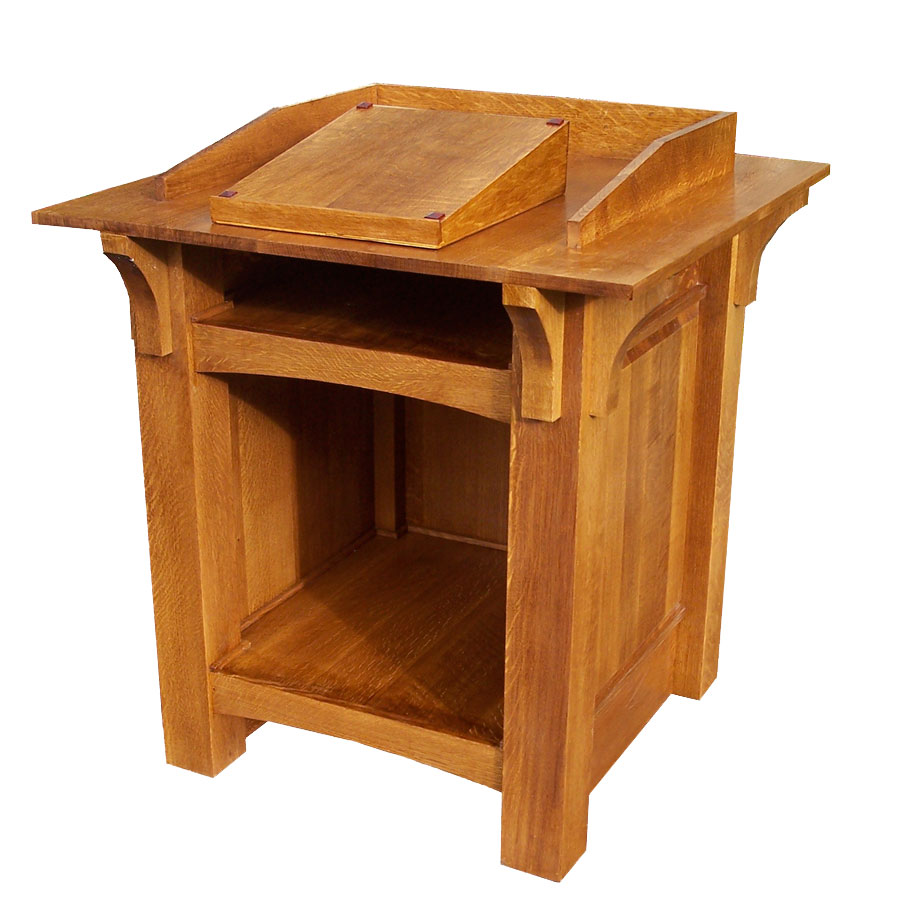
craftsman lecternThe Sentinel Mission Pulpit, the grandest product New Mission Workshop offers, came about as a commission from a pastor in a small church.

I’m very proud of the project for a few reasons. One, I designed it myself – and I still like the design; it came well; the pastor really liked it; it serves in God’s purpose.

Check out the photo documentary of the planning, building and delivery here.

craftsman lectern

 
Leave a comment

Posted by on January 24, 2012 in BlogNotes


Tags: , ,

WoodSmith Shop TV show

woodsmith shopSince the demise of Norm Abrahm’s New Yankee Workshop, I’ve been looking for a decent woodworking TV show. I think I may have found it. WoodSmith Shop is the TV rendition of the print magazine, Woodsmith and ShopNotes, and done well.

Here’s what I like – and don’t – about the show.

I like that the projects are usually decent and that they are deceptively easy to make. They show you shortcuts and lend tips along the way. They don’t used complicated techniques, like wood bending, or marquetry, nor do they use tools that are esoteric, like a mortising machine. It’s a show for the average Joe, not some guy that just graduated from the North Bennet Street School – though I’d bet those alumni could learn some tricks from this program.

They have several guys doing the show, one handing off one phase of construction to the other. The guy with the mustache is annoying, because he keeps this little laugh in his voice all the time, which is a pet peeve – but otherwise, he’s fine, lol.

You can find show times in your area here.

 
Leave a comment

Posted by on January 24, 2012 in BlogNotes


Tags:

Craftsman Mirror: Win!

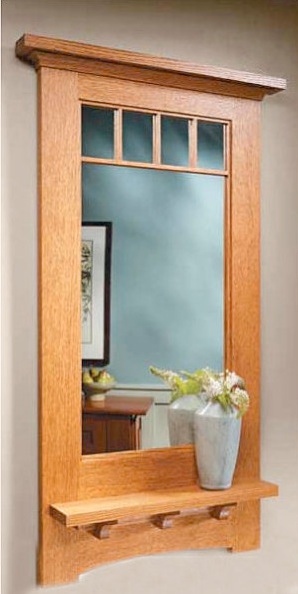
Crafstman MirrorWhile watching a decent woodworking TV show, WoodSmith Shop, I was interested in the Craftsman-Style Mirror they had featured on a recent show. Christmas was coming, and the mother-in-law needed a gift, so, I thought this would be a good one. The show detailed how to make the trickier parts of the project (thought it was a simple project), and they were giving away the plans free! Get them here.

So what went right, and what went wrong?

What scared me the most was making the cove molding, which sits under the shelf. They wanted me to use the angled table saw trick, which, admittedly, concerns me, putting side pressure on a blade. Just doesn’t sit well with me. Instead, I used a large Core Box router bit, taking several passes, and it came out beautifully.

The crown molding under the cap was a bit tricky, but I was never good at crown molding to begin with. Nevertheless, it adds a wonderful touch.

The small, 1/4″ muntins were delicate, and a bit tricky to make, but also add a great deal to the piece, breaking up the large glass surface.

I used quarter-sawn white oak, but they used plain sawn white or red oak. That is their picture you see here.

The tricky part was the mirror; they don’t tell you how to procure one in the plans. I went to a glass dealer and he cut me a nice 1/8″ piece, not bevelled, and not side polished, for only $25.

I used a special hanging bracket they highlighted in the show, which is well worth the $8 at Woodcraft. This is a hefty piece, probably about 15 pounds, so a good mounting is essential.

If you’re looking for a nice weekend project that will please the woman in your life, this might be it.

In total, the project was about $50….well worth it. It was well received by the mother-in-law.

 
Leave a comment

Posted by on January 24, 2012 in BlogNotes


Tags: , ,

Give me an “A”! No, make it an “E”!

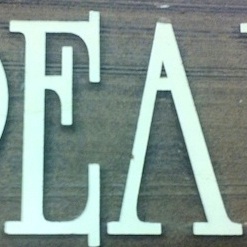
signSometimes, my work involves not the entire creation of a new piece, but working with a previously crafted piece. It might be a repair or renovation of some sort. This particular project was quite unusal, in that the client needed a previously crafted sandblasted sign’s lettering changed. She loved the sign, but it didn’t make sense anymore. The sign read “Piper’s Peak”. The Pipers used to live on a mountain, so “Peak” mad sense. Well, the moved, and the sign didn’t make sense…but she love the sign, and asked if I could change it. “Sure” I said….not even knowing how…. Read the rest of this entry »

 
Leave a comment

Posted by on January 24, 2012 in BlogNotes


Tags:

Curved Panel Small Clock

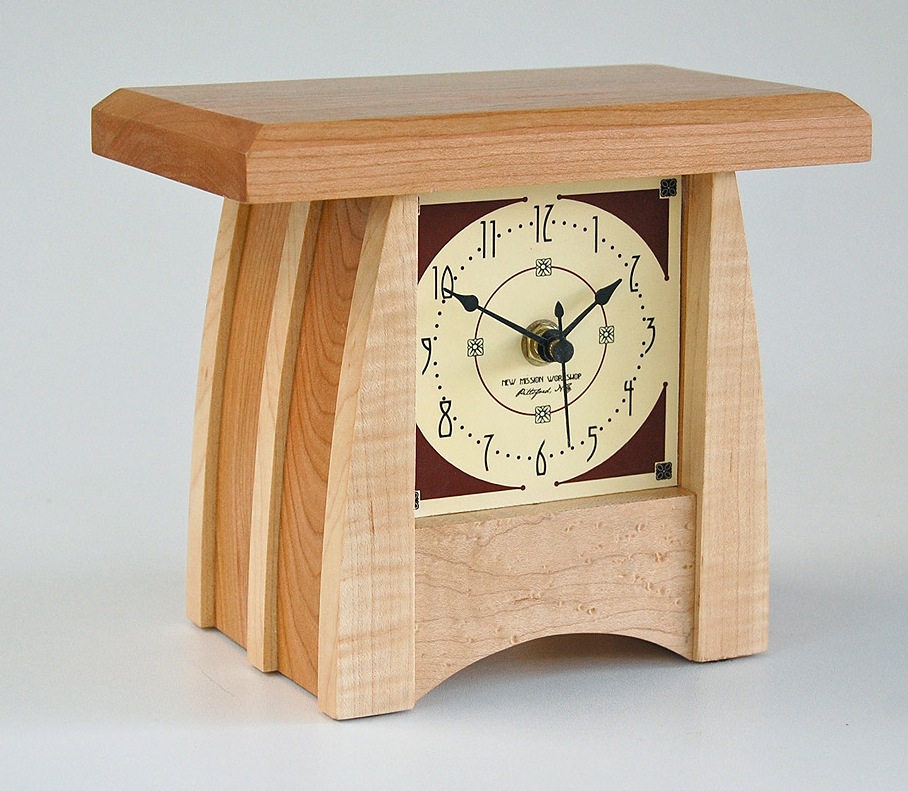
Craftsman clockAs per my previous post, I made a small clock with curved two panel sides, as a technical challenge. It’s now in my stable of clocks for sale.

I’m happy with the results; the curved sides add a unique flair you don’t see a lot in clocks – especially Mission or Craftsman style clocks (hence the name of my shop – NEW Mission Workshop).

The hardest part was of course the curved panel sides, but I made a jig for a router that makes pretty quick work of those side panels. Essentially, the router rides over a long crescent; the I rip the crescent down the middle, and voila! I have the two sides of the clock. That’s not quite the whole deal, it’s a bit complicated to explain in this blog, but that’s the gist. The paper clock face was my design as well; it’s done on archival quality paper, very thick, and then sprayed multiple times with poly to protect it.

All in all, I nice technical challenge with a nice result.

craftsman clock

Oh, the name of it? Childwold. It’s a very small blip of a hamlet in the Adirondack mountains, near to our summer cottage, and the name just came to mind for this piece.

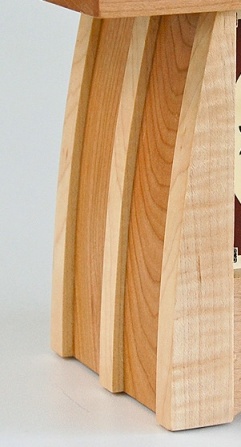
You can see a close up of the side in this shot. It’s maple and cherry. You’ll note I didn’t put a “rail” on the bottom of the curved panel to firm up that panel look; I tried it, but it just didn’t look right to me.

 
Leave a comment

Posted by on January 24, 2012 in BlogNotes


Tags: , , ,

Sketchup & MockUp: Powerful Tools

I’m developing a small mantle clock with a low price point for the Christmas season; I’ve been made aware that could be what people are looking for. Low price point, handmade, good styling – should translate to sales.

One tool of the trade I use often is Google’s Sketchup program. Usually, I’ll just work up the piece in that, and go right to building the piece. However, sometimes things don’t translate right, or I don’t see things in Sketchup that I see in a real piece; this is speaking from the experience of past projects.

SO, this time, I made the Sketchup drawing, produced a rough prototype, and lo and behold, found some things that needed to be changed, both technically and aesthetically. So, made the changes in SU (Sketchup) and will now go right to a finished piece.

Between those steps, however, is yet another. Since this mantle clock will be a small run production piece, efficiency is important; I don’t want to have to mill 8 different kinds of thicknesses, for instance. So I have to make sure the parts in the SU drawing have a minimal amount of different thicknesses, and will also make a cutting diagram to minimize waste and time. Like the saying goes, time is money, and the more quickly I can make these mantel clocks, the more money I make per piece. I actually need a play book – what I’m going to cut, how to buy the lumber (milled or rough), and so on.

 
Leave a comment

Posted by on January 24, 2012 in BlogNotes


Tags: , , ,