RSS

Category Archives: BlogNotes

Blogging about my adventures in woodworking. Yes, you will read it.

The Greatest Selling Tool of them all?

If you’ve read this blog for anytime, you’ll know I’m big on wow-ing customers. I think it’s important not only in procuring – but also in retaining customers.

There’s a lot of competition out there; you’ve always got to have a leg up on the competion. Well, I think I may have found the greatest “leg up” of them all.

My current big hammer is SketchUp and it’s rendering engine Kerykethea. Together, I’ve mastered them enough to be able to create a photo-realistic rendering of a piece. It’s a great tool for presenting a potential client with a project idea. You “build it” in the virtual world – without actually building it. Change woods, add things, delete them – all without creating dust. That’s a great selling tool for me, because I don’t believe a lot of woodworkers do that.

Well, being on the lookout for an even better tool to wow clients with, it struck me, once I saw an ad for this product – a 3D printer, in this case by Cubify.
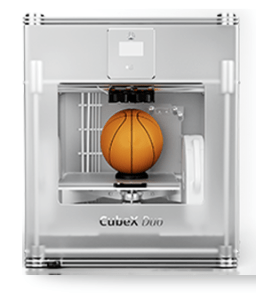
Cube X Printer

Was IS a 3D printer? Well, it “prints” out plastic replicas of whatever you design in their software, with exacting detail, in color, and with the ability to print very complex shapes, even moving parts. It’s crazy what these things can do.

So how to use this to wow a client? Well, how about instead of just sending them photo realistic renderings of a piece – actually sending them the piece?! Just in miniature. Something a customer could actually hold in their hand and evaluate. I think you could say you are the only woodworker – anywhere – doing that.

If that won’t wow a client, I don’t know what will! Back in the late 19th and early 20th centuries, salesman would actually take miniature samples of the their wooden products to potential clients – including miniature pianos. Obviously, taking furniture place to place back then was not easy; miniatures were.

And not only would it be a great sales tool, but a great shop tool as well. Since this model can print up to about 10″ square, imagine all of the things you could print out – parts for jigs, for example, or I’m sure, many other things that have to be custom. It’s essentially micro-manufacturing.

This model runs about $2500 – about as much as a cheaper CNC machine. Now granted, CNC machines make real items with real wood – the 3D printer is plastic (or metal like polymers in higher end machines), so you can’t print out a chest-on-chest – yet. But what a unique, useful tool – not just for the shop, but selling as well.

 
Leave a comment

Posted by on June 2, 2013 in BlogNotes


The Three Types of Woodworking Dogs

Bailey

Bailey, my Beagle.

All vocations have a pecking order, every company has a hierarchy. There is the newbie, there is the master; there is the new sales associate, and the CEO. The world of selling woodworking is no different; there are little dogs, medium dogs and big dogs, to employ some canine metaphors. There are also advantages and disadvantages to each, just as each dog breed has theirs. I have a beagle, and unfortunately, not really sure what her advantages are!


Read the rest of this entry »

 
1 Comment

Posted by on May 27, 2013 in BlogNotes


Tags: , ,

Who Were the Roycrofters?

Roycroft Magazine Pedestal%22

Roycroft “Magazine Pedestal”

The Arts and Crafts movement wasn’t all just about Stickley or Limbert; the Roycrofters also had a say in the matter; but who exactly were the Roycrofters?

Read the rest of this entry »


Tags: , ,

SketchUp – My Secret Weapon

sketchup

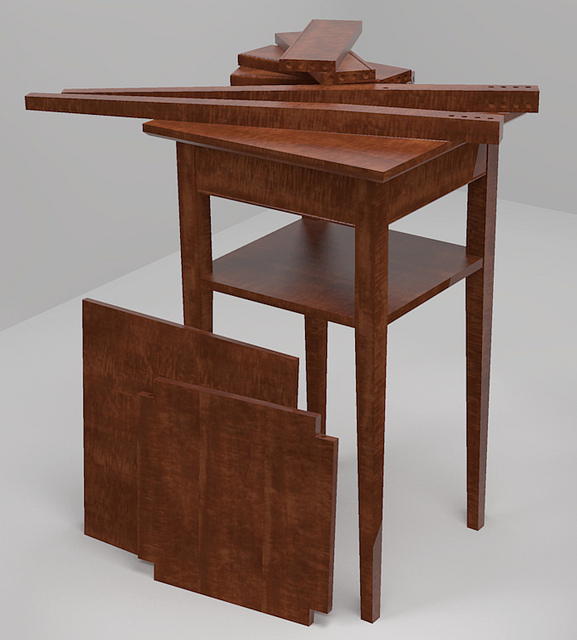
Mahogany table, by Dave Richards

Woodworking, as in any business, requires that you have tools at your disposal that the other guys don’t have, in order to beat them to getting customer dollars. I’m not talking about a dedicated mortiser here, but “tools” outside of the shop, such as marketing, great designs, technical skills, contacts, and such. I’m blessed, in many respects, that I was able to bring a lot of great tools to this profession – a good eye for design, website savvy, a great mentor, creativity, and others. However, I do have a secret weapon – SketchUp, a CAD program, free from a company called Trimble (although Google created it).

For those of you somewhat familiar with SketchUp, please come back from running away from your computer while pulling your hair out and yelling hysterically, while I tell you why it’s my secret weapon, and how it gives me a leg up on the most of the rest of my competition…

In my view, successful marketing involves at least one major component: Vision. Vision is being able to get across an idea to a client, in this case woodworking concept. It’s not enough to say, “Yeah, I could build you this nice bookcase with dentil molding, a recessed cove, two arched cabinet doors, in cherry.” Does that sound really enticing to you, if you were the customer? You might be a great woodworker, but I’m sorry, that kind of description doesn’t get across the vision for this project that you have to the potential client. You need to bring excitement, and create a strong desire. Instead, what if you could show him a photo of the bookcase, customized to his specs? If you’re really good, show him a photo of said bookcase installed in his home! You could show him how awesome it would look, and would certainly go a lot farther in closing the sale. Well, with SketchUp, and a rendering software package (both free) you could actually make this happen.

This is the beauty and power, of Sketchup. Not only can you create dead-on mechanical drawings for the shop, and know for certain they will work, you can create photo-realistic renderings (turning a CAD file into what looks like an actual photo), with no software cost! Change the wood type, move pieces here or there, play with contrasting woods, find weak joint designs, or illogical designs – it’s easy with Sketchup.

Grand Mission Desk

Grand Mission Desk by Patrick Ashley


Ah, and there’s the catch – it’s easy for me, now. It sure wasn’t always easy. I actually quit trying to learn it once due to frustration, but thankfully, I picked it back up again and made myself learn it with a For Dummies book, YouTube videos, and help from forums. It wasn’t easy – but it was worth it. I’m a bit new to a rendering program for the SketchUp files, called Kerkythea, but am coming along quite well. The photo in this blog post of the side table, is not real – it exists only on hard drive. A mentor of mine, Dave Richards (a SketchUp authority) made this in SketchUp and rendered it in Kerkythea. You can see the beautifully stained mahogany, and even make out the top coat sheen – a semi-gloss, I’d say. He has the finished piece, and all the parts exploded.

With my Grand Mission Desk, I was able to produce similar results; had I really taken the time, I could have projected this rendering into a real photo, and fool you into thinking this was a real world desk that has been built. As it was, I was only using the rendering to present ideas to a client (he’s buying, by the way), and I wanted to keep the “set” low-key, focusing on the piece, obviously. I have the ability to show the client the desk at any angle he wants, change wood types or stains – everything is very malleable. Can you see how this could give me a tremendous leg-up on a guy that has just sketched something out on paper, or send a photo of a real desk with an addendum, “Just imagine it a little higher, with corbels under the top, and in cherry.”

Yeah, thought so!

So there you have my secret weapon. It’s a challenge to learn, yes, but I really am very happy that I did take the time and pains to do so.

 
Leave a comment

Posted by on May 20, 2013 in BlogNotes


Tags: ,

Watch as Man Purposefully Puts Finger into a Table Saw. No, it’s not gory!

It’s not everyday you get to see a guy purposefully put his finger into a live table saw.

 
Leave a comment

Posted by on May 15, 2013 in BlogNotes


Need New Business Cards? Get them here.

moo.comI’m sorry, but if you’re business card looks cheap, I don’t think much of your business. I guess my thinking is, if you don’t care enough to put a few bucks into the presentation of your business, how much are you going to care when you provide your service and/or product to me?

I feel that way with your logo, business name and place of business too! But that’s another blog post…

Anyway, I wanted to tell you about Moo. I know, strange name, but it’s indicative of the company, in that they think outside the box, they are creative and fun, a feature I value in people and companies. They are an online printing company, and they have awesome products; I would call them the Apple of the printing world.

I forgot how I came across them, but very happy I did. I wanted a premium business card, cheap, like anyone. I wanted to be able to upload my own design, front and back. Moo accommodated those wishes, as seen here:

Moo cards

Obviously, the moo stamp is not on the final product. I got 50 of these cards, on really stiff stock, with beautiful color for….$5.50, shipped. Yes, that was an introductory price. But isn’t it great that I get these for  11¢ each?! When I place my order next time, of 200 cards, it’ll be $69.99, or 35¢ each. For this quality and level of service, yes, it’s worth it.

You too can get the same $5.50 deal here, and no, I don’t get any kind of kickback for it. The only kickbacks I get, unfortunately, is from my table saw.

They also have this very interesting product, Printfinity! where you can print a different design or photograph on every single card in the pack. Show off your products or your portfolio. So what does that mean for us woodworkers? Well, look at my card above. Imagine I’m at a show; I’ve got, let’s say, 5 big items for sale, including those two tables above. Moo can print my one side (let’s say your contact info side) all the same, but print 5 different reverse sides – each with a nice shot of the 5 different products. For instance, the Limbert table on the right. I can have Moo print up (for example) 100 cards with the table on the back, and set those cards right on that table for customers to take. So the customer gets a card with a picture of the exact product they were interested in at the show! When they take it home, they’ll be reminded again how much they loved it, and hopefully will buy. I can do the same for the other 4 products as well. I think that’s a great idea.

So, on my say so, try Moo – you won’t regret it.

 
Leave a comment

Posted by on May 15, 2013 in BlogNotes


Tags:

Compelling Quotes about Woodworking You Need to Read!

quotes icon• “‘… It’s not that there’s not a demand for fine woodworking – it’s that there’s a demand for fine woodworking with imagination.  The things that are considered classic now weren’t classic when they were conceived, they were innovative and imaginative.  The first Windsor chair was a work of art.  The 2,000th was just a copy.’” – Victor Di Novi


• “‘Often I’ll conceive and execute a project just because it’s something I want to do, not necessarily because I think it will sell.  Most woodworkers don’t allow themselves this freedom.’” – Victor Di Novi


• “Things like patternmaking, efficient use of materials and adapting machinery are all factors in the process of making a better product at a lower price.” – Tom Toldrian


• “in craft ‘design, function and technique come first; in art, form and content come first.’” – Stephen Whittlesey


• “If it bothers you that the chair is askew, just go to your local furniture store and look at chairs until you feel better.” – Brian Boggs


• “‘Of course I would like the business to make money so that my family lives comfortably, but I think the most important measure of success is making sure that the daily process of my life has meaning, and that it feels worthwhile.’” – Gene Agress


• “‘Too many times woodworkers make something and think it’s nice, but it doesn’t solve problems for people.” – Rich Robertson


• “Obstructions lead to creativity.” – Stephen Gleasner

• “In woodworking, mistakes wonderfully focus creative solutions.” – Patrick Ashley


Leave a comment

Posted by on May 11, 2013 in BlogNotes


What I Learned on the Stickley Factory Tour, part 3

stickley factoryThe Stickley factory employs some 900 people (up from only 22 people in 1974) from 36 countries, running two shifts in a huge factory, where the Audis (the family that bought Stickley in 1974) have combined multimillion-dollar investments in technology with Old World craftsmanship to make for a successful wood furniture company. There is no doubt in my discriminating mind that the Stickley brand is excellent; actually better than the product Stickley originally produced – because they have better glues, better finishes, machines that can cut more accurate joinery more efficiently and almost endlessly – then could be done back in the day.


So what did I glean from the tour, that I can use in my own one-man shop?

  1. Efficiency is King. You’ve heard the old adage, “Time is money”, and that’s very true in the production woodshop. The longer you take to make a piece, the more your labor per hour, which means less profit. The faster you can produce a product, in terms of taking it from rough lumber to a finished piece, is also a factor in your profit. Stickley uses machines to do work that must be accurate and quick – such as cutting tenons or mortises – because in doing so, they add value to their product, in that the piece would have more solid joinery, and appear nicer, not to mention cutting costs on how long it took to make that – table leg, stile, panel. In my next big project, a large mission desk, I’m going to try having my sawyer joint and plane and final dimension some of the work – to see how much time it saves me (money, sawdust, etc).
  2. Use machines when you can, and hands where you can see it. Think of it this way – what value is added for your customer by making tenons or mortises by hand (for instance), when a machine can do it more accurately and quickly? Conversely, fitting a drawer, picking out the best wood, hand finishing a topcoat – those are all things that DO add value for the customer. If you are going to spend costly time on a project, do it where it can be seen and appreciated by your customer. Imagine, if you will, having all the parts for that (for instance) desk delivered to you; the parts are dimensioned and sanded to your requirement. All you have to work on is assembly and finishing – the things that really matter. Maybe it’s worth it to have a bigger shop dimension parts for you? My sawyer does it for only $50 an hour, and with his bigger machines, I’m sure he can get a lot done in an hour.
  3. People expect the best – and will pay for it. People know the Stickley name for quality – and it better be there. They are willing to pay top-dollar for the best, and let’s face it, at least for mission style stuff, Stickley is the number one national (if not international) brand. Your reputation is everything. If you start cutting corners, and quality suffers, people aren’t going to love you anymore, regardless of cost. When people want the very best, honestly, they come up with the money.

So there you have it, some lessons from an amazing furniture company.

 
3 Comments

Posted by on May 11, 2013 in BlogNotes


What I Learned on the Stickley Factory Tour, part 2

(Continued from previous post….)

stickley assemblyIt seems Stickley makes runs on pieces – setting up machines and the required jigs and people – when stockpiles start running low, and then they put all these same pieces on a pallet (for instance, 100 pieces of spindles for a chair), and then move that pallet into a bin with all the other pieces needed for that project.

Many cuts are totally automated; our guide told us that drawer pieces (that is, the three sides and bottom) are all spit out of a machine; rough cut wood is taken in, cut to the proper size, sanded, even finished with a quick drying topcoat of some kind, and the piece comes out ready to use on the other end. Amazing. Tenons and mortises are all specialty machine done, of course.

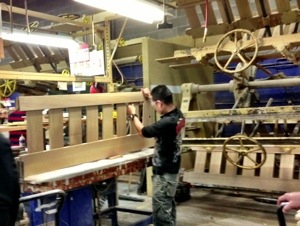
Assembly, from what I could see, was done by hand. I watched a craftsman assembling a panel of some sort with several tenoned boards; he selected the each board and installed it with best side facing out. Even clamping was done efficiently – with large presses, as seen in the pic above. This saves time, and has more even pressure across the whole piece, instead of selected spots – improved result, more efficient technique.

We also witnessed a guy who’s only job was to fit drawers into different case goods; a team that repaired pieces that came through the assembly, ready to have a finish applied – only to find a ding, veneer sand-though, or other unacceptable flaws.

We didn’t see actual finishes being applied – probably a trade secret – but we did see pieces that were finished set out to dry, and then finally the folks that do the final finishing touches on the pieces, with large vertical, portable light panels to move about the piece to aid in finding flaws.

The tour was quite good, and lasted about 45 minutes. I can say I have a deeper appreciation for their product, and certainly respect and admire their workflow. They are a truly classic American company.

(Next: What I gleaned from the factory tour)

 
1 Comment

Posted by on May 9, 2013 in BlogNotes


What I Learned on the Stickley Factory Tour

stickley factoryRecently, I was able to take the free Stickley Factory Tour in Manlius, NY, just outside of Syracuse. This huge building is where virtually all the Stickley furniture is made – some of the more inexpensive furniture is made in (Ugh) Vietnam. They give a free factory tour every Tuesday at 10am. Since it’s only about 1.5 hrs away, I took the tour.

I was hoping to glean helpful ideas from the tour, and I did, and I’ll share them with you.

Our first stop on the tour is where they make custom pieces – you, as a customer,  like a certain table, but you’d like it all in cherry, and a bit smaller. One dedicated guy will make the whole piece; the only thing he won’t do is finish it. They had quite a bit of incredible equipment – a band saw with a throat depth of 2′, and a blade 4 inches wide – which you would expect. They are given mechanical drawings, and off they go. In this area, we also met a guy who’s dedicated to making jigs. He’s told “This is the part we need to make, now make us a jig (or several jigs) that we need to make it. No plans for the jigs, he has to figure it out. Ugh. However, the lesson is, use jigs as often as possible to help with accuracy, cut more safely, and more efficiently.

We then entered the massive stockpile of lumber – Quartered white, cherry, sapelle, walnut, etc. A bundle was perhaps 10 feet wide by 12 feet tall, and probably 16 long. I saw at least 40 of these bundles on racks to the ceiling. Surprisingly, the grade of the wood is only B and C, not the A you would think. I’m not sure why they do it this way, but I would say it’s a lot less costly, and they can still get a lot of usable lumber out the wood (we were told 50% of the wood is wasted, used for heating the plant, shredded for farmers, etc).

The wood is scanned by a computer that takes hundreds of photos per second of all four sides, and decides the best way to cut it for least amount of waste. How and where it goes from there to get cut, I couldn’t hear (it’s quite loud in the factory, of course). I did see guys sorting out pieces that were cut, according to grade and size, and someone would make a pile on a pallet, to be used later.

Next, we came to a glue-up station, where they would glue up large blocks of long pieces, I’m guessing for large turned table legs. A worker would glue the pieces, stack them, maybe four high, then put them on a slightly-tilted-from-vertical bed. He’d put maybe 5 of these atop each other, then a large angle iron would be pressed down hydraulically onto these piles. He was doing several glue-ups at once, and using not clamps, but presses. Very efficient. The glue was Titebond, but colored a pale red, and I assume it would set up quickly.

We were informed that they do in fact use CNC machines for some work, placing a large plywood sheet down on a bed, being held in place by suction, and a computer would cut out the parts. I assume these parts were things like the backs of bookcases, or other case work.

NEXT: Mass cutting and assembly.

 
2 Comments

Posted by on May 8, 2013 in BlogNotes