RSS

Author Archives: pashley1916

What I Learned on the Stickley Factory Tour, part 2

(Continued from previous post….)

stickley assemblyIt seems Stickley makes runs on pieces – setting up machines and the required jigs and people – when stockpiles start running low, and then they put all these same pieces on a pallet (for instance, 100 pieces of spindles for a chair), and then move that pallet into a bin with all the other pieces needed for that project.

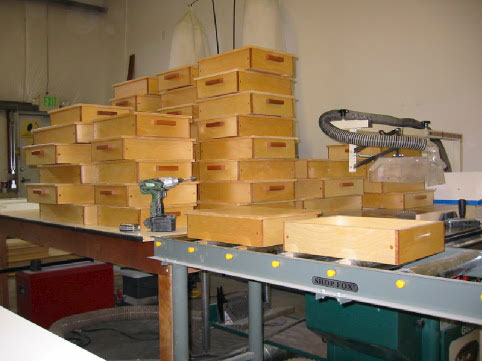
Many cuts are totally automated; our guide told us that drawer pieces (that is, the three sides and bottom) are all spit out of a machine; rough cut wood is taken in, cut to the proper size, sanded, even finished with a quick drying topcoat of some kind, and the piece comes out ready to use on the other end. Amazing. Tenons and mortises are all specialty machine done, of course.

Assembly, from what I could see, was done by hand. I watched a craftsman assembling a panel of some sort with several tenoned boards; he selected the each board and installed it with best side facing out. Even clamping was done efficiently – with large presses, as seen in the pic above. This saves time, and has more even pressure across the whole piece, instead of selected spots – improved result, more efficient technique.

We also witnessed a guy who’s only job was to fit drawers into different case goods; a team that repaired pieces that came through the assembly, ready to have a finish applied – only to find a ding, veneer sand-though, or other unacceptable flaws.

We didn’t see actual finishes being applied – probably a trade secret – but we did see pieces that were finished set out to dry, and then finally the folks that do the final finishing touches on the pieces, with large vertical, portable light panels to move about the piece to aid in finding flaws.

The tour was quite good, and lasted about 45 minutes. I can say I have a deeper appreciation for their product, and certainly respect and admire their workflow. They are a truly classic American company.

(Next: What I gleaned from the factory tour)

 
1 Comment

Posted by on May 9, 2013 in BlogNotes


What I Learned on the Stickley Factory Tour

stickley factoryRecently, I was able to take the free Stickley Factory Tour in Manlius, NY, just outside of Syracuse. This huge building is where virtually all the Stickley furniture is made – some of the more inexpensive furniture is made in (Ugh) Vietnam. They give a free factory tour every Tuesday at 10am. Since it’s only about 1.5 hrs away, I took the tour.

I was hoping to glean helpful ideas from the tour, and I did, and I’ll share them with you.

Our first stop on the tour is where they make custom pieces – you, as a customer,  like a certain table, but you’d like it all in cherry, and a bit smaller. One dedicated guy will make the whole piece; the only thing he won’t do is finish it. They had quite a bit of incredible equipment – a band saw with a throat depth of 2′, and a blade 4 inches wide – which you would expect. They are given mechanical drawings, and off they go. In this area, we also met a guy who’s dedicated to making jigs. He’s told “This is the part we need to make, now make us a jig (or several jigs) that we need to make it. No plans for the jigs, he has to figure it out. Ugh. However, the lesson is, use jigs as often as possible to help with accuracy, cut more safely, and more efficiently.

We then entered the massive stockpile of lumber – Quartered white, cherry, sapelle, walnut, etc. A bundle was perhaps 10 feet wide by 12 feet tall, and probably 16 long. I saw at least 40 of these bundles on racks to the ceiling. Surprisingly, the grade of the wood is only B and C, not the A you would think. I’m not sure why they do it this way, but I would say it’s a lot less costly, and they can still get a lot of usable lumber out the wood (we were told 50% of the wood is wasted, used for heating the plant, shredded for farmers, etc).

The wood is scanned by a computer that takes hundreds of photos per second of all four sides, and decides the best way to cut it for least amount of waste. How and where it goes from there to get cut, I couldn’t hear (it’s quite loud in the factory, of course). I did see guys sorting out pieces that were cut, according to grade and size, and someone would make a pile on a pallet, to be used later.

Next, we came to a glue-up station, where they would glue up large blocks of long pieces, I’m guessing for large turned table legs. A worker would glue the pieces, stack them, maybe four high, then put them on a slightly-tilted-from-vertical bed. He’d put maybe 5 of these atop each other, then a large angle iron would be pressed down hydraulically onto these piles. He was doing several glue-ups at once, and using not clamps, but presses. Very efficient. The glue was Titebond, but colored a pale red, and I assume it would set up quickly.

We were informed that they do in fact use CNC machines for some work, placing a large plywood sheet down on a bed, being held in place by suction, and a computer would cut out the parts. I assume these parts were things like the backs of bookcases, or other case work.

NEXT: Mass cutting and assembly.

 
2 Comments

Posted by on May 8, 2013 in BlogNotes


Why You Need to Learn SketchUp

Tools aren’t just in the shop these days, but on the computer as well. I think I spend about 1 hour on the computer designing for every 10 hours in the shop, designing either future products I’ld like to offer, or ones that current clients are requesting. I use a free product called SketchUp. SketchUp is a free 3D modeling design program for woodworkers (and architects, interior designs, mechanical engineers, etc), and is available for Mac and Windows machines. I need to have accurate drawings so I make less mistakes in the shop, and can create a better product. I enjoy the advantage of being able to create a custom project for a client, and almost build it before I build it, on the computer. That’s a huge selling point to a potential client. As someone that wants to sell something (maybe that’s you!) you need to remove any barriers to that person saying “Yes” to a sale. Not being able to visualize the product is one of those things. “Yeah, I can build you a cherry desk with two drawers” isn’t good enough; it’s too…sketchy. I can build you this cherry desk (showing the potential client a rendering) is a much better, and makes the client feel more secure. Also, learning SU (SketchUp), fosters creativity; you can mix and match woods, change any part easily, go crazy. More accuracy, better chances at a sale, fostering creativity – this is why I state You Need to Learn SketchUp!

   Learning SketchUp

The hardest part of SketcUp is learning to use it. I gave up once trying to learn it, but thankfully came back to it, and am quite proficient now. I reached out to experts like Dave Richards who has a free blog you can use at Fine Woodworking, titled Design.Click.Build. Dave has also put out a DVD and book for beginners, which you can find here. There’s also a “for dummies” book found here. And there are many videos on YouTube. Is it difficult to learn? I’d have to say yes. Is it WORTH IT to learn? A definite yes.

While in SU, you see a pretty crude model, but certainly good enough to work with. This is the model you’d work with to get where you want to be on the project.  Let me give you a real world example…

Piper's Folding Table

Piper’s Folding Table (click to enlarge)

A friend of mine had this table – it’s probably made in the 30s. It’s an interesting table in that it folds up, when you pull up at the center joint. There was just something about it that struck me. Here’s a pic of the actual table.


Piper's table SU model

Piper’s table SU model (click to enlarge)

Any way, I asked him if I could borrow it to make drawings – and so I went to work recreating it in SU. I took all the measurements, including the hardware, and the working model drawing came out like this. As you can see at this point, there is already a strong resemblance to the actual table. The change I made was using walnut as a texture, rather than the maple (I believe) that the original was made of. At this point, if I wanted to go ahead and build it, I would “explode” the drawing – moving the separate pieces apart and putting in ruler measurements for each piece, printing out the screen shots of the pieces, and going down to the shop to build it.


Piper table rendering

Piper table rendering (click to enlarge)

But let’s say that I’ve come up with this table on my own for a client, and wanted to present the idea to the client in the best possible light. I probably wouldn’t send the working SU model, but rather would render the project. What is a rendering? A rendering engine (program) takes a file from a CAD (computer aided design) program – in our case, SU – and “renders” a photo that looks realistic. Some CAD programs can do this from within itself, but many rely on external, third-party programs to accomplish this. I use Kerkythea (care-ka-thea) for rendering from SU.

So why would you want to go through all this trouble to render? Other than looking cool, what’s the benefit to a woodworker? Well, for one thing, it’s really not all that much trouble, and secondly, you get a much better idea of what the end product will look like – far better then the rather cartoonish rendering that SU shows you. More importantly, if you do woodworking professionally, you can show a potential client a piece that is already “built” and change woods, dimensions and scales easily. Make the mistakes in the virtual world before making big mistakes in the shop.

If you are already pretty proficient at SU – no mean feat – then you are ready for Kerkythea – it’s much easier to use then SU. It’s also free, like SU; you can get it here. I won’t rehash how to install Kerkythea – they explain it.

   SketchUp & Kerkythea = Awesomeness

If you use SketchUp for woodworking, and you really enjoy the way it helps you in the shop, you might want to take it to the next level, and get into photorealistic renderings such as Kerkythea; it’s a great tool to put the finishing touches on design idea, and getting that client to commit!

 
1 Comment

Posted by on May 4, 2013 in BlogNotes, Sketchup


Tags: , , , ,

Production: Too much or too little?

woodworking productionYou’re a one or two man shop; you’re doing pretty well with orders. You’re making ok money – but you want to up it a notch, because business is picking up – due to word of mouth, and advertisement you’ve been doing.

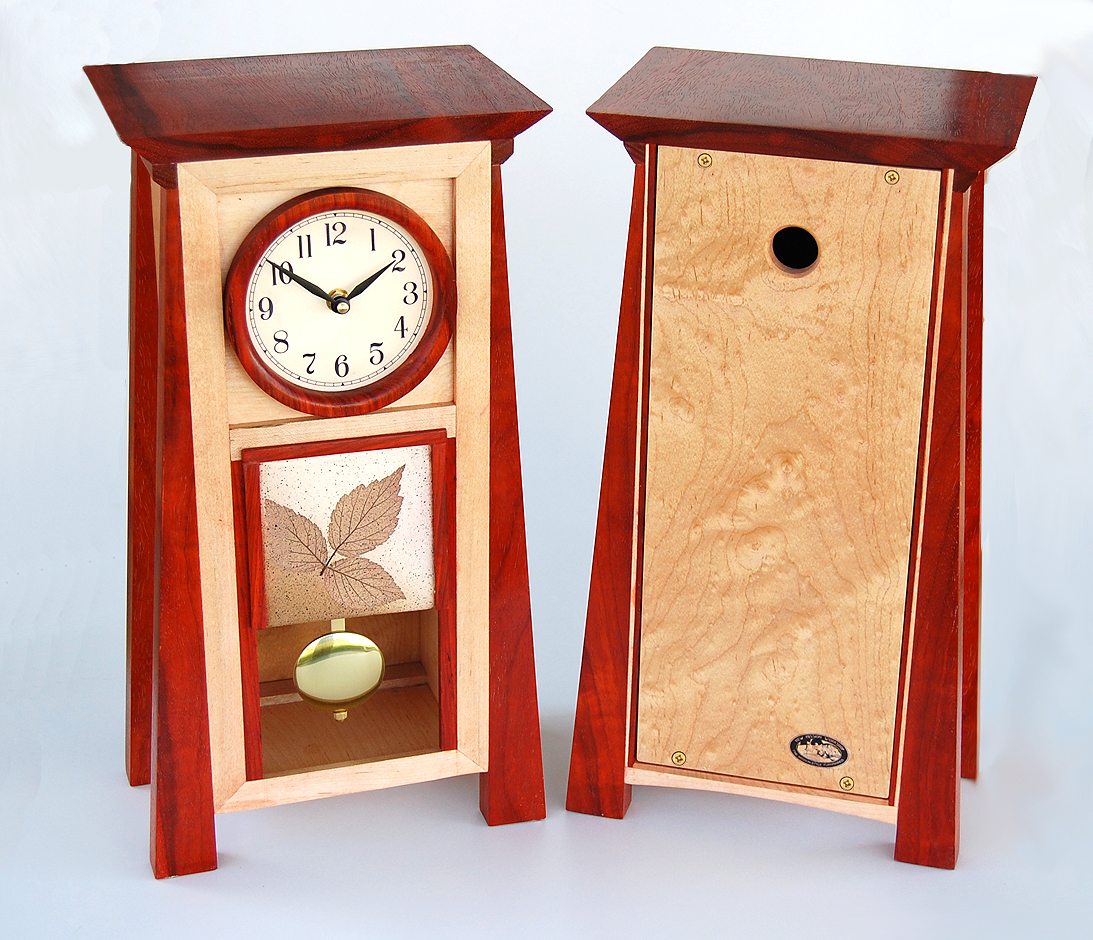
The problem? Production. Specifically, how much to do. What’s the right rate? If you’re making, for instance, mantle clocks, do you make enough for that day, a couple of days – or a huge run of, say, twenty?

They all have their good and bad points – but one is better then another…..

There is efficiency in bigger runs; it makes more sense to set up a jig once for a complicated cut, and then cut 20 pieces, instead of setting up the same jig 20 times – and risk not cutting them all the same. However, what if you do cut them all at 5″ and 6 degrees, and oops, it was suppose to be 6″ and 5 degrees? No fixing that one – like the barber says, “I can take more off, but I can’t but it back on”. You’ve wasted time and money.

On the other hand, if you go slow and cautiously, you’ll be inefficient – and still might make mistakes.

Then there is another problem – what if your parts supplier (in this case, maybe the clock movement) screws up – either the parts came and are wrong, of they come days later then you expected? Now your’e sitting on a dozen half-done clocks.

Make a little, or make a lot, each has it problems.

The answer lies in the middle, of course. Make four or six in a run. That way, if you do screw up, or you supplier messes you up, you’re not siting on a bunch of junk, or half-done inventory. You can put them away, and start on something else until the problem can be fixed. You can be both efficient and cautious.

 
Leave a comment

Posted by on May 4, 2013 in BlogNotes


Tags:

Side Project: Michigan Rummy Turntable

Rummy boardMy friend, an avid card player, asked me to make a Michigan Rummy turntable for him. Michigan Rummy is a card game played with chips. I really don’t know how to play, but I said I’d make him one, based on what I could gather from plastic “trays” found on the internet; some are just flat boards or sheets. He wanted something that could be spun from player to player for easier access.

It’s 16” across, and 1 1/2” thick, cherry top half, maple bottom half, with a lazy susan.

To give it a more professional look, I made water slide decals for the eight different card pools and the “kitty” in the middle cup. You can buy inkjet decal sheets at modeling stores; they have clear sheets, which I used here. You then give that sheet a thin spray of poly, and let it completely dry; two coats might be a good idea. Once that is dry, you cut close to the decal, wet it in a bowl of water for a few seconds, then place it where you want to transfer it to. after a minute or so, the glue has softened up, and you very gently slide the decal off it’s backing (I used a soft detail brush) and into place. Gently smooth out the bubbles, pat gently dry with a paper towel. There is a little bit of a trick to it, it’s delicate.

Finished simply with several coats of water-based satin poly.


2 Comments

Posted by on May 1, 2013 in BlogNotes


Tips on How to Sell Your Woodworking, Part Two

This is part two of a three-part series on how to sell your woodworking projects; part one can be found here.

  • Ask questions. Ask potential clients what they might need. Putting them on the spot forces them to come up with some kind of answer – that might be a “nothing, really, just looking” kind of answer, or it might be a “well, a new coffee table might be nice, our new puppy was biting on ours” – or some sort of response like that. I would advise you not to do the hard sell, like a used car dealer (“What’s it going to take to get you into this car today?!”) but rather point out the good things about your product – “This coffee table is all solid quarter sawn oak….you can see I use these very strong mortise and tenon joints…and the finish is four coats of poly.” You get the idea.
  • Everybody loves a good story. If you can tie a story to a piece, all the better. Remember, you’re not selling some cheap mass-produced junk from China, and can use that to your advantage. Maybe you’re selling a Limbert coffee table replica; you could point out some of the characteristics of that style, how you researched the piece in old books, visited an original in a museum in Boston, and so on. A story adds value to the piece.
  • Good photography – a must! Nothing ruins the chance for a sale quicker (at least online) then crappy photography. A white bed sheet as a background for your custom turned cocobolo salt and pepper grinders? Really?! The reason your photos aren’t good are becuase either A) you don’t think it’s a big deal, or B) You don’t know how to do it. Well, it IS a big deal – isn’t the piece you put hours and hours into worth taking a good photo to help sell it? If you don’t know how to take a good picture – and a lot of people don’t – consider having it either professionally done, or done by a friend that knows how to do it. If you like my photos of my products on the white background, such as this one, it was done on the cheap, by myself. The white is just a piece of sheet melamine (I believe it is melamine), 2’x4′, which is very thin and flexible. It is propped up on a table outside, under a porch, curved. The lighting is natural of course, always best. Yes, I used my expensive Nikon DSLR, but results could be just as good with an iPhone, and no, I’m not kidding (I will be doing a photography how-to in the future). Some very basic tweaking in Photoshop –  just contrast and brightness, maybe a little blemish or dust removal – and that’s it. Regardless, good photography is a must.
  • Gather testimonials. I usally ask my customers for a testimonial of a few sentences. Here’s an actual one from my customers: ” I’ve been looking for a source of hand-crafted mission lamps and was delighted to discover the New Mission Workshop. My new lamp is beautiful and well made, offering a warm finish and clean lines that are a perfect match with my home.”  I intersperse these testimonials on my web and printed media. Testimonials are valuable in sales.
  • Ask for the sale. When people don’t really need something – like a new toilet, food or gas – then they can hesitate to jump for a purchase. After your pitch, you might say something like, “Do you think you might want to see this in your home? I currently have a break between jobs, so I can get this done for you in short order” or, if it’s already a built item, “I can get this shipped out as soon as tomorrow, would FedEx be ok?” I’ve read that people that ask for the sale get it 3X more then those that don’t.
  • Remove all payment barriers. This factor is often overlooked. You should be removing all barriers for people paying you (within reason, of course). The more ways people can pay you, the less chance you’ll get the “That’s the only way I can pay you” line. Some people don’t like giving you, some guy, their credit card info (and who can blame them), or they don’t like using Paypal. They just want to send you a check – even cash. With checks of course, you have to wait several days for the check to clear their bank (ask your bank about details), but let the customer know your product won’t ship until it does – they’ll understand. If you’re at a craft show, or some other remote venue, you have to be very trusting to take a check, and hand over the goods. Instead, you might want to look into a credit card service like Square, which lets you swipe credit cards right on your smart phone!

In the next installment of this series, I’ll discuss where to sell your pieces.

 
1 Comment

Posted by on April 29, 2013 in BlogNotes


Tags:

Buying New Machinery for the Shop: What to Consider

Grizzly planerWe’re men; buying a new big piece of machinery for your shop is a thrill. It’s a new toy, something to awe over. I recently purchased a new table saw, and I took delight in comparing one saw to another, combing thru user reviews, looking for the best price. These tools can cost a heck of a lot of money (are you listening, Fein?), so you want to spend your money wisely.

This problem is compounded, however, if you are buying big power tools for a production shop – or, if you are just getting starting into producing pieces by the lot. At this point, the machine in question is no longer a toy so much as it is an investment in your business.

Ideally, machinery you purchase must either either increase the efficiency or the quality of the process being performed, preferably both.

You don’t necessarily have to go out and purchase the most expensive machine, either. As cool and amazing as it would be to have, Grizzly’s G03X 25″planer, at $10,350, it would be way more then I would ever anticipate using. Instead, something like their G0454 20″ Planer at $1,774 would be more appropriate. This is really a lesson in value; paying some $9,000 more wouldn’t give me more for my money then the smaller size model. If I was planning to go into kitchen cabinetry as a business…well, that might be a different story.

Of course, the flip side of this is you don’t want to buy the smallest and cheapest brand either (hello, Harbor Freight Tools). You need a dependable brand, and one with the capacity you anticipate, and the quality you require. As a general rule of thumb on these things, I make a choice on a product line (as in the Grizzly example above), taking into account the anticipated work I’ll be doing – and go one model larger (assuming that’s not a huge jump in price and capacity; I don’t want to go from a $2,000 20″ planer to a $6,000 24″ planer). This way, I figure I add a little elbow room for anticipated need.

So, some things to think about when buying a production-oriented piece of machinery:

  • What is my anticipated need for this machine? Will I ever be running a 24″ wide piece of wood through it, or will 20″ be all I’ll ever need? What kind of finish quality can this machine provide, and will that be enough?
  • Does this machine add efficiency to my operation? Is the extra cost worth that efficency?
  • Is this a quality machine? Is the maker reputable, the machine durable, the reviews on it favorable?

So get busy and start doing your homework!

 
Leave a comment

Posted by on April 28, 2013 in BlogNotes


Tags:

Tips on How to Sell Your Woodworking, Part One

Pat in shopWoodworking, of course, is not always about making a buck; plenty of us are in it as a hobby, for the pure enjoyment of it. We make stuff for ourselves and others; nothing wrong with that – but for those of us who are trying to make a buck at it, it can be tough. I’ve tried a lot of different things trying to make it – big time – in woodworking. I’ve done ok, but I’m not where I want to be.

So, in the spirit of helping out others, I thought I’d pass along some tips, tactics and strategies that have helped me out – and I hope they help you too.

• Selling is about need. A good salesman doesn’t just find a need to fill – as in, “You need a new medicine cabinet? I can build that!”. If you take that tact, you have to wait for them to come to you, to have a need to be fulfilled. Good salesman create a need. You might be asking, “But how do I tell that lady she needs a new medicine cabinet, when she doesn’t?” She needs the better one you have to sell her. Your cabinet can hold more things, has a bigger mirror, is made of cherry, which matches her bathroom cabinet, and so on. You create a desire, a want. Look at car commercials – you care is probably just fine – but don’t you want that hot Lexus on TV? The luxury, the styling, the driving experience? It all looks appealing to you. Again, creating a need where none exists. So how does this work in the woodworking world? Well, you take the car company tact, and make a product that appeal’s to a women’s sense of decor (most of our customers are women, let’s face it). You’re not going to sell a clock made out of a table saw blade – though that might work for some guy’s shop – but you can sell a nice mission style clock for her mantel. Women like to attract beautiful things to themselves – whether that be adornments, like jewelry or clothes, or their surroundings, as in your beautiful table, cabinet, clock, etc.

• Sell value, not price. You’re never going to beat the big box stores on price; it’s impossible. People will look at you like you have three heads when you tell them your mission mantel clock is $475, when, by God, they can get a clock at Walmart for $20! Off hand, their point seems valid, a clock tells time – in this case, one for $20, the other for $475, so why should they spend more? The answer is in perceived value. If that’s all they value, something to tell time by, then you’ll never make the sale. However, if they value the story behind the clock – how you picked out the cherry yourself, crafted it yourself from your own plans, and how it is much more visually pleasing then the white plastic, made in China clock that won’t last for more than 5 years, and isn’t something you’ll be handing down to your heirs, like your clock will be – now you’re talking about value.

• Differentiate yourself from competitors. Why should I buy from you? What makes you better then this other guy? It’s not always about price, by the way. You could sell yourself on many traits – you have over 20 years making clocks; you have a long list of customer’s testimonials; your design is unique – yet very appealing, you use mechanical movements while others use electronic movements and so on. Of course, your product should be the number one thing that differentiates you from others – the quality, craftsmanship, styling – all need to be appreciably better then other woodworkers. You must stand out, and above.

• It’s about relationships. Not the one with your girlfriend, or your wife (!), but with the customer. People like to feel special, and they feel special when they have a relationship with someone that is special. This explains the lures of celebrities; why do people come off positively giddy when they meet Tiger Woods or Kim Kardashian? One chase balls around a country club; the other chase balls all over the country. These people are special – in that a lot of others think they are special – so when you have a moment with them, however brief, you feel sort of special too, and you run back and tell all your friends whom you just met. Well, to your customers, you are kind of the rock star, in a mild sense. People are thrilled to have stuff custom made for them, especially by someone who is percieved to be a very good craftsman. Think about it – what if Sam Maloof made you his famous rocker, or Krenov, his cabinet – just for you? Wouldn’t that make you feel great? Well, that’s how your customers should – and really do want – to feel. Once you get that customer, be personable from first contact forward. You don’t have to be their best friend, but you don’t have to an aloof cashier at 7-11 either. You hopefully can build some relationship with the person, and therefore, future sales.

Watch for my next post in this series….
 
2 Comments

Posted by on April 28, 2013 in BlogNotes


Tags: , ,

It’s Not All About the Money

smiling woman“Got it! Love it! The stain color is just what I wanted and I like the cranberry stain on the little insert pieces because there is a slight bit of that color in the wallpaper. I will send you a photo when it is decorated and up on the wall, which should be soon.”

“There are not enough superlatives to describe how beautiful and wonderfully made this clock is and what a delight the artist is. And Patrick made this just for me! Such care and craftsmanship – it is truly a work of art. All materials are exceptional and the whole is a treasure for generations. I adore it and will be a repeat customer. Enjoyed the whole process. Thanks, Patrick!”

” I’ve been looking for a source of hand-crafted mission lamps and was delighted to discover the New Mission Workshop. My new lamp is beautiful and well made, offering a warm finish and clean lines that are a perfect match with my home.”

The comments above are actual testimonials from my customers.

I think people forget just how ingratiating kind words can be from customers – wether that be a woodworker like myself, someone in an office, or a cashier. Yes, money is nice, but kind words really go along way (at least for me) and costs nothing for the person making the comment. On the flip side, making a kind comment to someone (heartfelt of course) is a great thing to do; you can really make someone’s day, and who knows, maybe their life, if they are at the end of their rope; your kind words could be the safety net that saves them from doing something stupid.

I enjoy what I do – and I get paid pretty well for it – but a big part of that pay is the kind words of appreciation that my customers bestow.

 
Leave a comment

Posted by on April 26, 2013 in BlogNotes


Tags: , ,

Etsy and You, The Woodworker

  • etsy

If you haven’t heard of Etsy, and you are a creative arts person, you should look into it as a place to sell your stuff.

The basics: You open a “shop” and sell your stuff, and people find you, and buy your stuff, through Etsy, who gets a modest cut of the action, about 3.5% (you can see their fee structure here). There’s no set-up fee, and it only costs twenty cents to list an item. Your buyers can also leave feedback. It’s really a turnkey solution.

But it might not be the right venue for you, the woodworker, depending on what you make. Overwhelmingly, the clientele on Etsy is women, in the 25-34 demographic. Just landing on the home page of Etsy, where they put up popular products will confirm this. The big seller categories are jewelry, textile items, craft supplies, and home decor items. It very much reminds me of your local craft show, only much nicer. Photography is usually very good, if not borderline professional; if you can’t photograph well, and aren’t willing to learn how, you might opt out of Etsy right away – unless you hire someone to do it for you.

So, what sells – woodworking wise – on Etsy. Well, our crafty (lol) friends over at CraftCount can help us out with that, they keep tabs on the best selling sellers.

  • MRC Wood Products With over 17,000 products sold, this guy is on to something! He sells custom engraved signs, which are, admittedly, very nice, and does so cheaply, in the $35 dollar range, which puts him in the Unique / Inexpensive / Home Decor category, which is a great place to be. Obviously, it works.
  • Timber Green Woods With a distant 9,700 sales, TGW features sustainable gifts and laser cut wooden ornaments. So, for those green folks out there, this is easy. I’m a little puzzled that ornaments do a such a decent business though. Still, he’s in that more affordable price range for his product, which helps a lot.
  • Bosheree Again, another custom home decor sign company, in the $35 dollar range, with over 7,000 in sales.

Those are the top three. Here are some other woodworking shops doing well, more in the vane of the ordinary woodworker, like us:

  • Boxnmor – Bandsaw box items, also banks and gnome doors. Over 4,000 sales.
  • Andrew’s Reclaimed – Actually, one shop I like. This guy rides the reclaimed / green train, and makes all kinds of “holder” things for home decor, including planters, and again, in the $20-$30-$40 dollar range. Over 3,500 in sales.
  • BarnWood4U – Uses reclaimed wood, in it’s weathered state, to make shelving and picture frames, in the $40 range. 2,000 sales.
  • Gray Works – This guy has a live edge / plank cut / rustic theme going on here, making cutting boards and small bowls, in the $50 to $75 range, mostly. Nice stuff. 1,800 sales.
  • CircleCreekHome – Talk about an esoteric genre – vintage wood stools! $30-$50 range, 1,700 sales.
  • Canadian Wood Crafts – Made to Order Hair Forks and Sticks , Baby Rattles, Natural Teething Toys, Toddler Feeding Products Coffee Scoops, Saute Tools and other Wood Utensils, in the $15-$30 range.

My advice? If you think you can come with a novel, inexpensive home decor item geared towards women, Etsy might be for you (as a woodworker). You might sell a few bigger ticket items (highest I’ve done is $850 for one piece), but I don’t see how you can make a living doing furniture and case goods via Etsy alone. Having said that, there very well maybe guys on Etsy doing exactly that, but I haven’t come across them.

 
1 Comment

Posted by on April 25, 2013 in BlogNotes


Tags: