RSS

Category Archives: BlogNotes

Blogging about my adventures in woodworking. Yes, you will read it.

Technical Challenge: Curved 2 Panel Clock

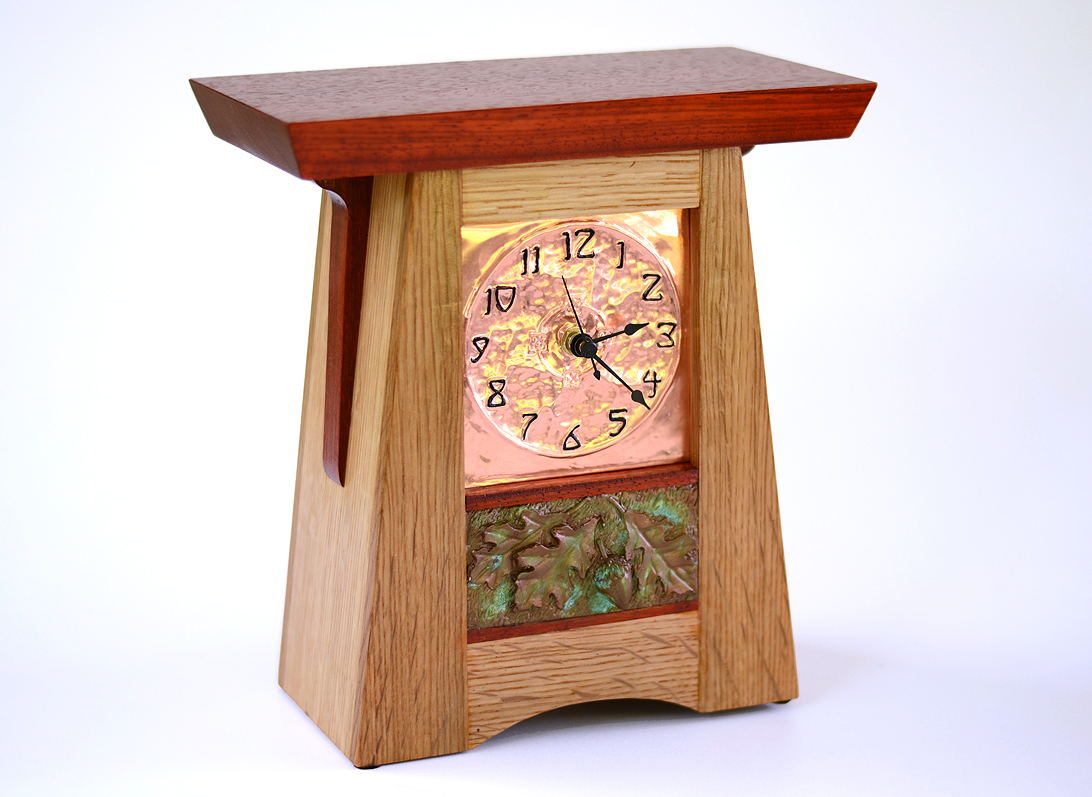
mission style standTwo panel doors or sides are handsome on their own; however, how do you bend them? I think it would make a great look for a small production clock I’m designing – but how to carry it off without bending wood?! I liked the Mission Style look that this piece add – with some added flair.

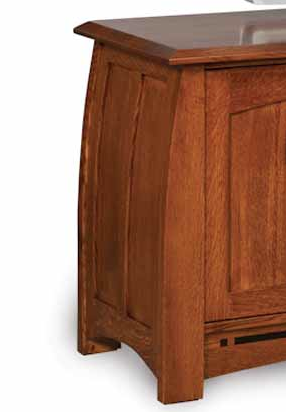
While looking for some furniture ideas, my wife and I came across a cherry credenza with two-panel sides, seen here. Very handsome. What really caught my eye, both atheistically and technically, was that the two panel sides werecurved. Having made two-panel cabinet doors before, my mind immediately went about trying to understand how the craftsman carried off that little technical feat. The panels are usually made of thin plywood, to control expansion (among other reasons), and if they were steam-bent, seemed like quite a bit of work for production pieces. Not to mention this is suppose to be “Amish made” stuff, so you’d think all the technical stuff would be kept rather simple.

I also happen to be looking for ideas for a small production clock for the Christmas season; something small, cheap, easy to make, and even easier to sell. I thought this curved side addition would be great – if I could pull it off without a lot of fuss.

Woodworking and magic have some things in common; the principle one being making things seem like something they are not. Obviously, I couldn’t deconstruct and reverse engineer this piece, dang it, so I had to use my imagination – and Google’s Sketchup – to help me make it happen.

Since my intended piece would be small – in the neighborhood of 6″ tall – bending was out. Also, trying to incorporate mortise and tenon joinery, as well as routing grooves in the stiles and rails was also out – too small, too much time.

This is where the magic wand comes out.

I happened to notice, when looking at the actual credenza, that the intersections where the rails and stiles meet the “panel” was tight – really tight. Master-craftsman-of-the-world tight. Looked awesome, of course, but not what you’d expect in a production piece. In other words, it looked too good.

Eventually, I thought those panels might not be panels at all, but simply bandsawed stiles – only thinner. Look at the stiles – the very long pieces of the panel frame; theywould have to be bandsawed out of slightly thicker stock (if not steam bent from regular stock) to get that curve. Why not bandsaw the panels as well the same way, but out of (obviously) wider stock? When you put the pieces together, you get the curved panel effect shown here. You would then have to joint down the panels to make them look thinner then the stiles. When you look from the interior side, you’d have a flat surface. As shown in the last picture.


Now this illustration was for cherry rail and stiles, with maple “panels”. If you were go with a single wood, perhaps just QSWO; then I believe you could actually simply cut one wide piece curved on the bandsaw, then cut that piece vertically into a stile, panel, stile, panel, stile, and then just joint down the “panels” an eighth or quarter inch to get that recessed panel look. I think it would be a very nice look.

So, that’s the idea – a theory – on how to make these curved 2-panel doors. In my next installment, I’ll report on how I did on a trial run of this theory!
 
Leave a comment

Posted by on January 24, 2012 in BlogNotes


Tags: , ,

Mass-Market furniture. UGH!

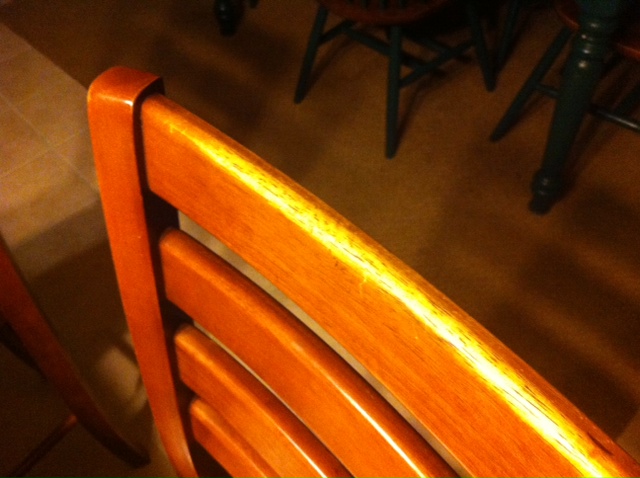
Mass market chair from Thailand with finish rubbing off!

With few exceptions, furniture from mass market retailers is awful!

Maybe I’m being unfair because I make furniture – or maybe I’m just the right guy to know what is good – and what is bad – furniture.

I’ll make my case. From my experience, I see three different kinds of furniture being produced out there; one is the Sauder put-it-together-yourself stuff, typically sold at Wal-mart, K-Mart or Target. This is basically a kit made with “engineered wood” – essentially, saw dust and resin to make fake wood. It’s then covered over in a “laminate” – essentially a sticker, a wood “photograph” – to make it look like the real thing. They actually do a fairly good job replicating the real wood look. You get an instantly smooth surface with the exact amount of sheen the manufacturer desires. If you spill water on the outside of the “wood”, you can wipe it up quickly with no damage; however, if the water seeps into a “joint” – where there is no laminate, the water will damage the engineered wood e

asily, turning it to a mush fairly quickly. In fairness, water is never a friend to wood, but this stuff just goes down the tubes with moisture. They have these hidden cam and dowel fasteners that work ok, but certainly Sauderaren’t as tight as real joint with glue. Does the finished Sauder stuff look good? Yes, it’s looks OK, from a distance; but it won’t hold up for a long time to real-world use, especially drawers and tops that get a lot of use, such as kitchen tables – which interestingly, they don’t make!

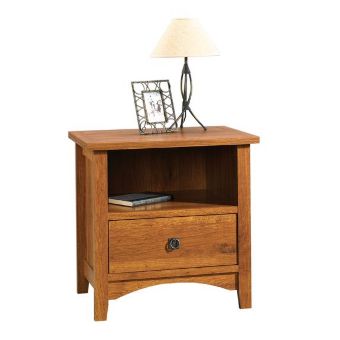
The Sauder stuff isn’t all that cheap either; this mission style nightstand goes for about $150. It’s only 25″ x 18″ x 25″ – pretty small. It’s suppose to look like oak. I can tell you right now, I could replicate this nightstand, in real oak, for less than $50 in materials, and you’d have real wood, and a piece that would be solid for life. Ah, but the labor! If you produced it in a small shop that did, say ten at a time, I bet you could make them for about $200 each. However, all some people see is a price tag, and even if you put a real wood identical piece next to this put together abomination, they’d picked the latter every time. Simply, they are fooled.

Next up, we have real wood pieces made in other countries, typically China, Mexico or Vietnam. You’ll typically find this stuff in your mass market furniture retailers like Ashley Furniture (no relation – my last name is Ashley!), or other local kitchen furniture stores or general furniture stores regionally. To be fair, some of it is made in the US as well, but that doesn’t mean it’s better. What it means is slammed together parts with a cheap finish. You’ll find drawer fronts attached with staples, and a finish that will literally, rub-off. Before
I got into woodworking seriously, we bought furniture at the stores as well. Here is a picture of the finish rubbing off of a pair of bar stools. That should NEVER happen – especially, the color! The “finish” is simply colored shellac (probably), and when it rubs off, both the protective coat and the color comes off. This is cheaper to make of course, because you can both “stain” the piece and top coat it in one operation. This chair is also made with a hardwood I’m not familiar with, but is very hard, though not attractive in grain. I’m assuming it is a species from Asia. In fairness, the chair has held up well mechanically; it’s just the finish that stunk. As I recall, these chairs were about $325 each. This furniture typically won’t last either, especially heavily used items, like kitchen chairs or couchesThen we have the third category of furniture – the real stuff. This is stuff that could have been mass-made, yet was done so correctly, and was finished by hand. I’m talking about Stickley or Amish furniture, and of course, furniture made by craftsman like myself, or Kevin Rodel, who are both Mission style fans. Mission style seems to be favored by furniture makers because of it’s straight line designs, making for easier production. Mission style is also quite timeless. In this third category, you’ll find Mission Chairfurniture made of all solid wood, such as cherry, maple or oak. Also, some is made of plywood – but for the right reasons. Plywood is not just the stuff you see on the sides of houses being put up, with the ugly knots; plywood can have a fine wood veneer, such as maple or cherry. You’ll find furniture craftsman using it in such cases as table tops and shelves. Why? Because for one, you can’t get a piece of cherry, for instance, 12 inches wide – you can with cherry plywood. Another reason is movement; wood contracts and expands depending upon humidity. This can warp or crack table tops, or raise problems with joints. Plywoods are very stable due to their engineering, and move very little. They are not that much cheaper either, usually comparable in price with solid wood counterparts.With craftsman-produced furniture, you’ll get furniture that will last a lifetime, if taken care of decently. High-quality brands, such as Stickley, tend to keep their value as well, and should they need to be refinished and/or repaired, a competent craftsman can make it look like new.There is a difference between price and value; price is a one-sided component. Value is getting to most “mileage” for the amount of money you spend. You can pay $150 for the nightstand shown above, and have it last 5 years, or, spend $200 and have it last the rest of your life.Which is the better value?

 
Leave a comment

Posted by on January 24, 2012 in BlogNotes


Tags:

Smaller Mission Style Clocks

Mission clockThe gauntlet has been thrown down before me. I was visiting with my local coffee shop that displays my work for sale, and was made aware of an event they are planning in December – bottom line, I need to get some cheaper product in there for that event, as people will be looking for things for Christmas!

The parameters:

• Easy to make, yet looks complicated to make.

• Stylish, in the mission or new mission way.

• Low price point, and hopefully high profit margin.

So now I basically have to come with a design like you see here that I can crank out quickly en masse, that will have a low price point and people can’t resist.

Sketchup, are you ready!?

 
Leave a comment

Posted by on January 24, 2012 in BlogNotes


Tags: ,

Missing Stickley Mission Style End Table

I was looking around the net for some furniture; the wife wants me to make some end table to accompany our new living room furniture on order. Yes dear. What was getting to be an eye-glazing chore turned out to be a great find!

All the ones I came across, in an image search, were pretty generic.

Then, I came across this one. Wow. Now this is what I’m talking about! Distinctive, mission style, and beautiful! No pain in the butt spindles to make either.Stickley table

Here’s the back story to this piece: It is a an actually Stickley design, a prototype never put into production. It showed up at a Sotheby’s auction in 2006. What makes it quite unique is the splayed legs. Usually, when you think about Stickley legs, they are symmetrical and perpendicular to the floor. Not the case here.

Plans for this baby? FREE! You can get the whole story, and the plan at Popular Woodworking.

Yes, the wife loved it too. I think I might modify a bit, to put my own touch on it, but I think overall this is a great piece.

 
Leave a comment

Posted by on January 24, 2012 in BlogNotes


Tags: