
RSS

Author Archives: pashley1916

The $7,000 Lamp

Mission ceiling lamp

“Prairie Lightbox” by Kevin Rodel

Since I’ve been woodworking, I’ve really grown to appreciate items made by hand, by a craftsperson of some kind – I don’t care whether that’s soaps, jewelry, leatherwork, woodwork, stonework, metalwork, painting – you name it; if someone has a passion for a discipline, and is good at what he or she does, I’m lovin’ it, to steal from McDonalds. I also understand now why hand-built items cost a lot more than machine made, one-is-the-same-as-all-the-rest stuff. AND, I also understand that people that are at the top of their field command a top dollar.

But $7,000 for a lamp?

No, not one made of gold ingots or diamond encrusted. Wood and stained glass. Not that large either, made for a dining room.

Well, one of my fellow woodworkers, Kevin Rodel, commands such a price for his ceiling hung lamps or “light boxes” as he calls them, on his website.

Are they beautiful? Stunning. Are they made out of the best pieces of cherry and other materials, and with the highest construction quality? Undoubtedly. But how much of a market does one have for this? How many rich people have bungalow or Craftsman style homes, and are willing to shell out this kind of scratch? I’m guessing not many, but I’m sure there are some. When people want something bad enough, price isn’t really an issue – just ask a crack head.
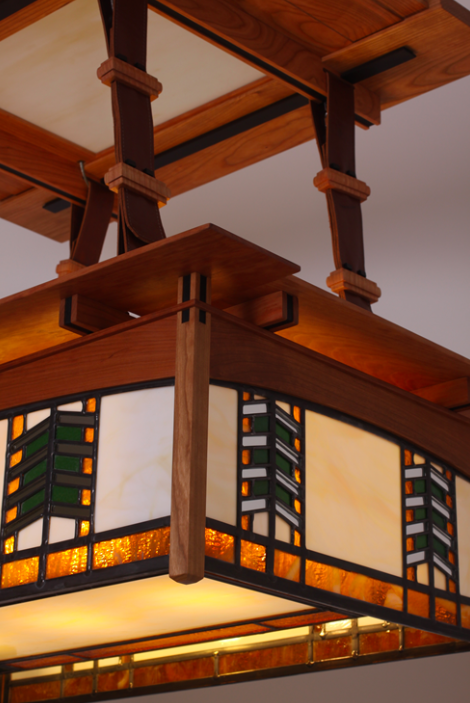
Mission ceiling lamp close

Wonderful detailing

I can tell you with a good degree of certainty that the materials cost – even given the almost certitude that Kevin out sources his stained glass work – is under $1,000. In the photo on this page, he states this piece is 39″ long by 25″ wide and 12 1/4″ deep. The matching ceiling bracket is 34″ by 24″. And you can see, the piece is mostly glass. I’m guessing there is $50 in wood, maybe another $50 for the leather straps, and perhaps $75 for the electrical? There’s got to be then, about a $6,000 gross for him. Yes, I know that it must take him some time to craft this piece; it IS very intricate, and has a lot of details; but it’s certainly not as labor-intensive as say, a relief carving. Given his level of expertise, I’m guessing he has no more than 40 hours of work into this himself. That’s $150 an hour. Does his level of professionalism command that price?

I’m not sure I can answer that. Certainly, he’s a top notch player in the Arts and Crafts genre of woodworking – just look around his website. Guys like him can really call there own shots on pricing; they have mastered their craft, established credibility (Rodel is also an author of an Arts and Crafts book, and authored articles in Fine Woodworking, and teaches as well.) and have a client base. I’ll leave it up to you to decide if that price is right – please note, I’m not knocking his price.

What I really wanted to explore is a sub-text of that pricing. That’s the highest price I know of for a piece like that. If you look at all of Kevin’s stuff on his website, it’s all high-priced. Again, maybe he can command that price – the guy does great work. But let’s look at it from the (rich) consumer’s point of view. Let’s say you are a rich lady, and you want to furnish your bungalow home you’re restoring in Pasadena. You look around on line for the best pieces. You find a couple of ceiling lights that are very nice, in the $1,500 range. Then you come across Rodel’s page, and see his wonderful work – at $7,000! What must you think? My guess is, you’ll think something like “Wow, his stuff is really beautiful, he must be a top notch craftsman to be able to ask that much!” In other words, the higher the price, the higher his quality must be. If you have a lot of money, and you want the best, well, you’re probably going to go for this lamp. It’s true that better things cost more…and this is most expensive lamp you’ve seen….so…it must be the best.

There’s also this “halo of awesomeness” that pieces like his will impart. Yes, the piece in an of itself is wonderful – but the knowing the high price for it amplifies it’s “awesomeness” as well. It’s an interesting effect, and definitely factor’s into it’s perceived value. People like us often mistake the psychological impact of price. I’m willing to bet that if you took that same piece – use the same photos even – and showed it to a group of people with a spectrum of income middle class to upper class, and told them one is $1500 and the other $7000, most of the people would say that the $7000 one is better.

One other issue – Rodel gets to work less, and be paid more. Nothing wrong with that; he can make, say, 5 of these a year, at $7,000 a pop, or 15 a year at $2,300 each. Which would you rather do?

 
2 Comments

Posted by on March 8, 2013 in BlogNotes


Tags: ,

Craftsman – What’s Old is New Again

limbert tableOriginally, Craftsman was not just a style, but a way of life.

Let’s go back….to the late 1800s. The industrial revolution is over; many things are made by machine now, especially furniture, though the furniture is still the same old style, just made faster – and more shoddily. Craftsmanship is pretty much gone out the window. People are sick of the industrial lifestyle – hard work in terrible conditions,  economic and social conditions that are unsatisfactory. Feeling separated from nature. In England, William Morris, an artist and writer leads a movement away from these troubling conditions, ushering in the age of the Arts and Crafts movement, and furniture that is later called “Craftsman” or “Mission” style (for an explanation of the difference, see my blog post Craftsman, Mission, Arts and Crafts – Whats the difference?).

The Arts and Crafts movement wasn’t just about furniture; it was about simplicity, wallpaper, home design; bringing in earthy tones and natural materials and simple man-made materials like wood, stone, tile, stained glass, animal figures and so on. It was an evolution – though going backward, in a sense.

But this is a woodworking blog, so we’ll focus on that. Studying the craftsman style, one will see simple symmetrical pieces with only moderate embellishment (and even the embellishments were simple). Joinery is solid, lasting, simple – witness the mortise and tenon joint. Embellishments were as simple as an arch in a stretcher, all the way up to inlays of beautiful, though somewhat simple patterns of different colored woods, and even some metals such as pewter and copper.

But why was this so? Again, it’s going back to the reason for the Arts and Crafts movement, and I think it’s worthing being aware of – especially today, when we have furniture atrocities in the manifestations of IKEA and home assembly fiber-board “furniture” from Wal-Mart, that has very little style, and certainly won’t last.

No, what their philosophy was on the matter of furniture is quite insightful. Gustav Stickley, whom one could really call the father of Mission furniture (at least in America), felt that those things that we want to keep around us in are home (furniture) should be as carefully selected as our friends; they should have certain qualities and characteristics before we allow them into our heart and home. He felt that inanimate objects like furniture have their own honesty, characteristics and qualities as well. If they do their job – their designed purpose – in a way that is consistent, done well, and are attractive pieces – then they should be welcomed into our homes. Which makes sense, when you think about it – would you want an ugly, uncomfortable chair whose leg sometimes collapses in your home? I would hope not; though some people put up with it. These pieces, Stickley felt, then become like old friends, which only adds to the richness and comfort of your home.

He addresses the craftsman (the person), saying, to paraphrase, that if he created a piece under duress, on an assembly line, with no passion, and no care for the creation, then the piece reflects that. However, if he has shown great passion in his work, and carried it out technically well, then the created piece will reflect that wonderful sentiment throughout it’s existence. In a sense, the craftsman breathes a soul into a piece.

And it’s quite true. If you are a good woodworker, do you have pieces about your home that you made that really add to your life? Would you miss it if it was gone? I know I do. I have a beautiful coffee table I made, and sweated over, refinishing it three times, because I didn’t get the finish right; it was one of my first major projects, and I had quite a time with it. But it turned out wonderfully. It is solid and attractive, and perhaps one day, my kids will enjoy it as much as I do.

Now, THAT is good woodworking.

 
Leave a comment

Posted by on March 3, 2013 in BlogNotes, The Craftsman Style


How to Make it Big in Woodworking

Sam Maloof

Sam Maloof

Are you the type of woodworker that wants to make it big? That is, have clients waiting for months from a piece from you; will pay the price you ask, and be featured in magazines? Many of us aspire to be; I know I do. Some of us are just content making nice things for ourselves and family. Nothing wrong with that. The guys that do well in this business are far and few between – at least it seems that way to me. Not that there isn’t a lot of talented guys out there, there certainly is. I’m speaking of the guys in the vein of a Sam Maloof, James Krenov or even Kevin Rodel. I have an aspiration to be in that league.  Let me make it clear – I’m not “making it big” right now in woodworking – either in standing or monetarily;  but I am continually working my way up, improving my skill sets, and wanted to share what I am doing – and trying to do – with you.

Like all professions, successful people in this field have certain traits and skill sets that, in my estimation at least, take them to the very top. In fact, it’s a pattern, of sorts; if you follow this pattern, you too may find yourself on top of the woodworking world. What I’ve listed below is probably not all-inclusive, but I think it does speak for a great part of that pattern I spoke of.

Originality. A lot of guys can take a plan and make a good piece from it, just as competent musicians can play great established tunes; but a great woodworker will be able to design a great piece, and carry it out, just like Lennon and McCartney wrote good songs and performed them.  Plainly put, if your design stinks, you’re going nowhere. Would we have heard of Sam Maloof without his rocker, or Krenov without his cabinet? Maybe not – they may have been just another very good – but not great – woodworker. Charles Limbert, Greene and Greene, Charles Rennie Mackintosh – all took from the Stickley Brothers; they designed along the same lines, but put there own design flair on the craftsman style.

Technical skills / Perfection. You need to be a proficient, if not an excellent, skilled craftsman; if you’re not, don’t bother selling. I’m not saying you need to be able to hand cut blind dovetails, build award-winning federalist furniture, or be skilled in the way of the Jedi Masters, but you need to have a piece that has solid joinery, and a very good, if not great, finish – at a minimum. Be proud that your name is on that piece of work. Personally, I try to be a perfectionist, at least in areas of a piece that are readily seen. If not, and that piece is going to be in my eyeshot, that little imperfection is all I’ll ever see on that piece, even thought it may be a great piece otherwise. In fact, I find that I have to not look at the piece for several months (if not a year or more), then go back and look at it, with “fresh eyes”, and re-evaluate it again, before I can say, “Yes, that one’s ok.” Aim for perfection.

Passionate. You need to show you have a zeal for woodworking. How do you expect others to get excited about your pieces, if you don’t? So how do you show passion? Well, you can show it in your descriptive text concerning the piece, or when you are showing it to a possible patron.

Photography. What good is building a great piece, if you have crap photography? I see so many guys with just abysmal photography. A white bed sheet draped over your couch as the backdrop, and a cheap cell phone camera, seriously? I get you may not have decent equipment or be trained in how to take a good photo – nor do you wish to learn how to do so – but get somebody who can. Maybe a photography student from a local college that is looking to beef up their portfolio. Doesn’t your piece deserve to be presented in the best manner possible?

Marketing. Forget craft shows, unless you just want to sell cutting boards, or other cheap items. Let’s face it, there isn’t, unfortunately, a big market for good woodworking. You need to leverage the power of the Internet, because a national, if not international market is required. My advice? Yes, you can have your own website – and not spend much, if any money; just use WordPress for your platform. Alternately (or in addition to), get an account at CustomMade.com. I’ve done fabulous on that site, and their fees are decent. I don’t see any benefit of selling thru a retail location on commission (seriously, you want 50% of my take? I’ll give you 20% max; you’re putting no money into stock, just a little space in your shop; sorry lady).  Etsy is ok, but that’s very much a craft woman’s place. It’s not much for expensive furniture, though smaller wood pieces do ok.

A Story. People love to buy into a story, whether it be the piece, you, or both. I’m not saying you have to write Moby Dick, but give the people something for their imagination to bite into. Here’s an example of what I mean, for, let’s say, a mantle clock:

Small craftsman clock, all maple, from a classic Stickley design. 17″ x 12″ x 5″.

Snooze. Now how about this….

I took the design of this clock from a piece I viewed at the estate of George Eastman, founder of Kodak. I asked the curator to let me take photos of it for design purposes. The wood used for it was actually from a tree that was blown down in a storm from his estate’s property, right here in Rochester NY.

So, which is more interesting to you? Same clock, different description. As for yourself, can you add anything? Something like this, perhaps:

My shop is located at the base of Whiteface mountain, in the Adirondacks of New York state. I buy my lumber from a local sawyer, as I like to support the local economy. Wood crafting has been a passion of mine since my grandfather took me into his shop some weekends, when I was only 15, and together, we made some simple, but useful pieces. I still have a small side table we built together…

Or, would you rather have something like this:

Woodworking since 1989. I’m a mechanic by trade, but I do this on the side. My shop is over 1200 square feet, and I have all DeWalt power tools, and is in the Detroit area…

Well, do you see the difference? When people spend money on a quality piece – and let’s face it, the stuff the better guys make is several times more expensive then what you’d buy at a retail furniture store – they don’t want just a piece of furniture, but a story behind it as well.

Reputation. Having one helps – a lot. I’m talking about being in Fine Wood Working magazine, or on a show, magazine, or other prominent venue. This will come in time – if you are good. My mentor is such a man. He can have all the commissions he wants. Thing is, he doesn’t do practical pieces, like furniture, but he does art woodworking – sculptures and such. When you think about it, a great idea. For one, not many guys do it, and for another, clients who want art usually have a ton of dough to be able to blow on it.

So there you have it, my observations on how to make it big – or at least, bigger. If you have any ideas on this topic, I’d love to hear it.

 
1 Comment

Posted by on February 18, 2013 in BlogNotes


My World-Class Mentor

Bill Keyser

Bill Keyser

I’m pretty involved in my church; in addition to going to Mass every week, I’m also the website guy,and a player in the church’s play group. I’ve made a lot of good friends, from many disciplines of work. One of those people is Bill Keyser, who I like to consider my mentor. He’s a world class woodworker; he studied directly under the famous danish woodworking professor, Tage Frid, a major player in the studio furniture movement, at RIT’s School for American Craftsman. Bill has also had his story recorded at the Archives of American Art at the Smithsonian Institution. He’s also been in Fine Woodworking magazine. He is known in the Rochester, NY area for his liturgical work, and his abstract art work – both in wood and painting.

In other words, a hell of a resume!

I was over at his studio in Victor, NY last night. I asked him to show me how to properly do a 4 sided taper on a short column for a candlestick. I tried several times to do it on my own, and couldn’t make it happen, despite researching it on the ‘net. It’s not as easy as you might think! Bill of course, made it happen quickly, using two jigs. It was quite the shop he has too – mostly older power tools, like a Delta Bandsaw that seriously had like a 14″ cutting depth, and probably 12″ resaw capability; a Delta cabinet saw which had a router table extension on it, and then a shaper added on to that as well. Plenty of clamps and carving tools adorned the walls. Lots of projects simultaneously happening.

I was then graciously invited into his home by his wife Joan, a very nice lady, who specializes in – for lack of a better term – food staging. She’s the lady that makes food look so good in ads so cameramen can photograph it. She told me a few of the tricks of her trade – like making something like a hamburger look juicy – it’s coated with vegetable oil. Their home is a contemporary style, and adorned with Bill’s sculptural work, and practical work as well. We had a few refreshments, and great conversation, then I made sure not to make a pest out of myself, and left in due time. Very nice people to chat with.

I hope I can learn some more from Bill in the future; I don’t want to be a pest of course, but perhaps I can pop in from time to time, and have him show me some other interesting techniques from the hands of a master.

 
Leave a comment

Posted by on February 13, 2013 in BlogNotes


Doing with Wood What God Does with People

I believe in God; if you don’t, keep reading anyway. I didn’t believe either at one time.

Not only do I believe, but I’ve considered what He does with what we would otherwise consider bad or unusable things, and uses them to His greater Glory. The greatest of all, is of course, what happened with Jesus. Here God took the worst thing man could do to God – killing him – and turned it into the greatest thing God could do for man – saving and redeeming him. Then we have examples of figures in the Bible of less-than-perfect people being used to do great things – such as Moses and King David, for example. God is quite a turn-around artist!

Yes, but how does this all tie into woodworking?

Many woodworkers look for the best woods – the most desirable figure, pleasing grain patterns, color, no defects (such as knots) and so on. You can’t blame them; it makes for a much smoother project completion.

Then you have guys that want to take what others wouldn’t even consider using for something beautiful and useful, and turning it into something that is just that. The table at left was built from …a single 2 x 4. You know, the things normally used in carpentry work, such as making walls? They cost about $2.50 at Home Depot. They are usually knotty pine, but also Spruce fir as well. Many are far from pristine – knots, twisted, bowed; small chunks missing and pretty ugly. Few are straight and true. They are to the woodworking world what Doritoes are to a chef.

But this fellow  took on the challenge, and had a dream to do it. To get those gentle curves, woodworkers steam the wood to make it pliable to fit around a form, and secure it there until it cools. Softwoods, like pine, are a real bear to bend, and he makes an accounting of almost giving up it was so difficult. Hardwoods like oak, not so bad.

And look what happened. He took an otherwise run-of-the-mill piece of lumber – something that otherwise would have probably ended up in a wall, and made it into something beautiful and useful. Well, that’s what God does a lot of the time too, takes situations and people that we would consider hopeless, useless and senseless, and turns it into something useful, helpful, even healing. In fact woodworking, on any level, is much like what God does, because by definition, we are taking something raw, and making into something beautiful and useful (usually), or at least utilitarian.

Thinking about it, it’s kind of interesting how the Bible tells us that Jesus was a carpenter. In His day, he not only took wood and transformed it into something great, but men’s hearts as well.

And that makes Him the true master craftsman.


Leave a comment

Posted by on January 8, 2013 in BlogNotes


Am I a Woodworking Snob?

I get quite a bit of my work from a certain website. Basically, buyers looking to have someone build them a project. Kinda like Match.com for woodworkers and clients. It works pretty well. They have a job board you can search through for these jobs, and then contact the posting party. Some things are beyond my scope – such a 30′ dining table with 16 chairs, but then again, some things are right up my alley, like cabinetry or smaller furniture.

Then there is some stuff is just awful, and I wouldn’t do it even if I could – because it’s a god-awful looking project that I wouldn’t even call furniture, let alone be something I could say I’m proud to have build (and surely not to have in my portfolio). Here’s the piece I’m referencing:

My god, what exactly is that?! In the description, it says “Simple Coffee Table” and “something for newspapers and magazines”.

How about something for the fireplace?

I don’t know who should be shot first – the guy that made this, or the guy wanting to have someone build something just like it.

I would never build this. Yes, call me snooty, if you must. But I would never have my professional name associated with this….thing.

The interesting part is, that with that amount of wood – albeit knotty pine, the box wine of the wood world – you could make a half-way decent coffee table. In fact, you can even make a decent piece of furniture out of one 2 x 4 ! You can read all about this project here, at LumberJocks.

More and more, I’m finding that woodworking is a lot like many other pursuits, such as playing a musical instrument, in that many people can do the basic stuff – such as read a plan and put a project together ( or in the case of music, read music and play the piano), but very few can actually create well – that is, create something new and nice, and do it very well. Everybody remembers the Beatles, but no one knows the “tribute” bands. And like this single 2×4 project, people can remember what this man did with just a single piece of lumber, while we forget the millions of pieces of 2x4s out there holding up walls and floors.

 
4 Comments

Posted by on January 7, 2013 in BlogNotes


Tags: , ,

Sanding: A New Era?

Sanding is such a pain. The dust, the amount of time, the different grits; the swirl marks, the inaccessible spaces, contoured surfaces, etc! I hate doing it – it seems to take forever, not to mention having to look for swirl marks, watching out you don’t create a divot by sanding in one spot too long, or having to change paper every 3.2 seconds.

The thing is, it’s so critical to have a smooth, scratch-free surface for your finish. You can have a great project – wonderful design, tight joints, beautiful wood, and so on, but if you don’t prep that wood correctly, you’re finish will just make it look awful. I think for a lot of woodworkers, finishing – and that includes sanding – is the weaker part of our skill set.

Complicating things, how far do you sand to? I’ve heard guys say that just using a card (or cabinet) scraper is enough, or that 180 is fine, while some take it up to 400 – or beyond. Then you have the issue of some woods taking stain worse than others – blotching cherry comes to mind; and don’t forget end grain staining darker than surface grain!

I’m starting to make a few bucks at woodworking, after putting in my due, and of course, time is money. Sanding just takes way too long. A necessary evil? A cost of doing business?

Maybe not anymore.

No, i’m not talking about getting one of those multi-thousand dollar drum sanding machines – though they are kinda nice, if you have the room, thousands of dollars, a 220V outlet, and a industrial dust extraction system. And don’t forget, you have to change the belt grits manually. Ugh.

Hopefully, I’m about to change all that. I need to. Not only would I benefit from this new way of sanding, but you would too. 

I’m developing a system to cut down the amount of sanding time – by about 75% – and improve the results to boot. Not only brainstorming, but I’ve actually tested this system. This system is hand sanding – old school – and not some new expensive machine; don’t cringe. I was able to gauge how much faster my system is by taking a piece of lumber and after planing and thickness planing it, scribbling over it with a pencil (as you would before thickness planning it to see if you flattened it correctly), and then seeing how long it would take to “erase” those marks. In my estimation, this is a great way to gauge if you’ve sanded enough, and if you’ve sanded the board (pretty much) completely. I used the random-orbit sander as you should, flat to the surface, and not just one edge. I then used my hand sanding system with the same grit – 80, and it was amazingly faster. Not only that, but since I went with the grain in my hand sanding method, there was no swirl marks.

Other benefits of my system, in addition to the amazing speed, simplicity, and superior results, is that the sandpaper lasts substantially longer than the random-orbit sanding disks you bought at Home Depot. No noise, no expensive tool to buy; just quick sanding with great results. What’s not to love?

I’ll keep you posted on the progress.

 
Leave a comment

Posted by on January 3, 2013 in BlogNotes


Tags: ,

Measurements: Always the Master?

Measuring woodOkay, we all know as woodworkers that measuring is part and parcel of our trade; we have to measure lumber in order to get things to fit. But is measuring a severe master that must be always obeyed?

Obviously, some measurements must be strict; a door has to fit into a cabinet, for example, and has an 1/8″ gap – that you have to measure carefully.

But how about when you screw up? Maybe that top of a table that your plans called for was to be 1″ thick. You plane the pieces down to…OOPS! 15/16″! I know that I (and I’m sure, some of you guys) would go mental and toss that wood aside and starts on new pieces, because, dang it, that’s what the plans called for! Besides that, the length of the boards were supposed to be 6′, and you screwed that up too, and cut them to 5′ 11 1/2″ ! Obviously, you need to pay more attention to your measuring. But my point is, does it matter? I’ve come to the conclusion, that in many cases, no, it doesn’t. Nobody is going to notice that your table is a freakin’ 1/16″ thinner than it should be – unless you have some psycho customer who will go over your piece with a fine tooth comb. That’s up to you to find out.

As for me, I’ve learned that measurements aren’t always king – that aesthetics and function are; obviously, a door has to be perfectly rectangular, or one side the top of a clock the same as the other, but you don’t have to sweat small, almost imperceptible measurements. Sweat tight joints, if you want to sweat something – but not a table top being 1/16″ less than plans called for. Don’t get me wrong – you always want to follow plans as precisely as possible, because what you think a mis-measurement of 1/16″ won’t matter, sometimes, down the road in the construction of the project, it will – and then you’ll have to get really creative; but many times a little screw up is not such a big deal.


Leave a comment

Posted by on December 10, 2012 in BlogNotes


CustomMade.com

About a year and a half ago, I entertained the idea of joining custommade.com, a website in which craftspeople like myself are connected to prospective customers looking for custom made crafted products; not just objects of wood, but metal work, apparel, glasswork, and more. Not only do craftspeople submit their items for sale – a portfolio – but there is a jobs board in which potential clients submit “want ads” that craftspeople can bid on. In theory, it was a great way to bring these two parties together (where else would you go if you wanted a custom pet bed or stained glass window?).

Problem was, from my perspective, that they wanted in excess of $500 to buy an account. That was a lot of money for essentially a cooperative website, so I didn’t buy into it. I don’t recall if they also wanted a percentage of your sales. So, I begged off.

It’s tough selling woodworking online. Problem is, people want a great table, but refuse to spend (for instance) $2,000 for it, when they can but one at Ashley furniture for $600 – and hey, it looks great! Never mind the finish will wipe off in about 2 weeks, and the legs will start getting wobbly just in time for dinner. Another disadvantage is that people can’t see the piece in person – they can’t feel how solid it is, touch the smooth finish, admire the beauty of the wood, from a small picture on their computer. You also have the problem of search engine results – if you aren’t on the first page (if not the top three results) on Google, you might as well not bother; people aren’t going to find you. So not only do you have to be an expert at mortise and tenon joints, but in search engine placement; and then, hopefully you will be considered for the job (if you have a great looking website, by the way). I won’t sugar coat it – I wasn’t doing squat for sales – and I was trying very hard. I designed web sites, briefly, so I can put together a decent presentation.

Obviously, people have to know you exist for them to buy from you. You can pay for advertising in an appropriate magazine – figure about $500 an issue – or trying putting up your own website, paying someone to do that and experimenting with pay-per-click ads on Google – which never worked for me either. Look, we are woodworkers, not marketing geniuses; we just want to sell our stuff. We don’t have thousands to throw at websites, search engine optimization, hosting fees, advertisements and so on. What’s a good solution for us?

Turns out, it IS CustomMade.com. I revisited them a few months ago – I was always interested in their model – and discovered that they have changed their pricing structure; they only charge one dollar a year now, and take 10% of your sales – a fair amount. The website is also vastly improved (expect for their confusing messaging system between client and maker), and they obviously have interest from prospective clients, as evidenced by the over 1,000 job requests on their client board. So, I bit the bullet and joined. You’re on my website, and I’m sure you’ve seen I sell off of here (as well as Etsy), but having another venue is not a bad idea. Turns out, it was a great idea. I’ve gotten more business there than I ever have anywhere else – and I’ve only been on about 3 months. I wished I’d had joined a year ago (or whenever they changed to this new model). Also, you can dictate terms for payment – typically, that’s 50% up front, 50% on delivery, but that can modified to suit your arrangement.

So let me give you some tips on CustomMade. First, you need to be pretty darn good as a woodworker (or jeweler, stained glass artist, etc), because the guys already on there are VERY good, and you’ll have competition. If you have pictures of your work, they have to be very good – not some crap of a clock against a wrinkled laundry sheet, or such ( I should put up a blog post about how to take good photos). You should have at least 10 items in your portfolio, and your profile filled out. Your profile photo can be your logo, a decent head shot of you, or of your in your shop – but nobody really cares what your shop looks like, honestly. You IN the shop? That’s better. When you go looking for a job posted by a potential client, don’t just reply, “Yes, I’ll do that for $500” Make it a pitch, sell yourself. If possible, show them a concept drawing, either freehand, in Sketchup, or an image from the Internet. The tenor of your pitch should be “business friendly” – that is, businesslike, but not a rigid robot. Instead of “I can do that sewing cabinet – $500”, say something like “Hi Jane, that’s a very interesting project you’re looking to have done. I did something similar with my medicine cabinet – which you can see in my portfolio. I took the opportunity to re-sketch that project to hopefully fit into your vision for this project – hope to hear from you.” Something like that. People want to be wooed a little bit here.

Let me stress too, that you need to exceed expectations for customers, not just meet them. I’m not saying put gold leaf on the project, but things like keeping the customer up to date with pictures and messages (which increases excitement), shipping it earlier than expected, packing the piece professionally, including a nice little thank you note inside the cabinet, things like this. Give them what the big-box stores won’t. If you wow your customers, they are going to come back, and they are going to tell their friends about you, and that’s exactly what you need to depend on for future sales.

So that’s been my experience; I haven’t had much success with Etsy, my own website, or even advertising; but I have had great experience with CustomMade, and I would recommend them.

 
Leave a comment

Posted by on November 27, 2012 in BlogNotes


Tags:

Do What You Love; The Money Will Follow.

I’ve had a lot of bad jobs in my life; whether that’s a low-paying position, bad work, or a combination of both. Digging ditches? Done it. Washing dishes? That too. Muffler repair, McDonalds, grave shift at a cheese factory, photo-lab manager, computer repair – check, check and re-check. Some jobs involved working with real jerks; others were back-breaking; some paid squat. Most were a combination of all those. Some were boring beyond belief; others frantic. One thing I learned: nothing makes you as miserable (save an awful spouse) as a job you have to go to every day that you hate.

I left the traditional working world about 11 years ago because my job was being moved out of state, and my daughter was just being born, so we made the decision for me to stay at home, and nurse along my woodworking career. No, it wasn’t easy, though it sounds like it might be. There were emotional issues to deal with I won’t share here. Nonetheless, I did it, and we plodded along. Now my woodworking skills are becoming increasingly in demand – I’m busy all the time. My work is my passion, and not a lot of people can’t say that about their work. I can work all kinds of crazy hours – or not, and you can’t beat the commute.

If you do very well at your job, people will see you out, and pay you well, especially in this line of work. It’s very gratifying to have people be very pleased with your work – as opposed to slaving away in a cubicle and rarely getting even a “Great job” comment. I personally delivered a set of nesting tables to a customer a few days ago (my Mission Nesting Tables), and received some great comments; moments later he was mentioning he would be wanting six chairs for a dining room table! How great is that?

Things are moving in my direction; I guess there is something to that maxim, “Do what you love, the money will follow” 🙂

 
Leave a comment

Posted by on November 26, 2012 in BlogNotes