RSS

Author Archives: pashley1916

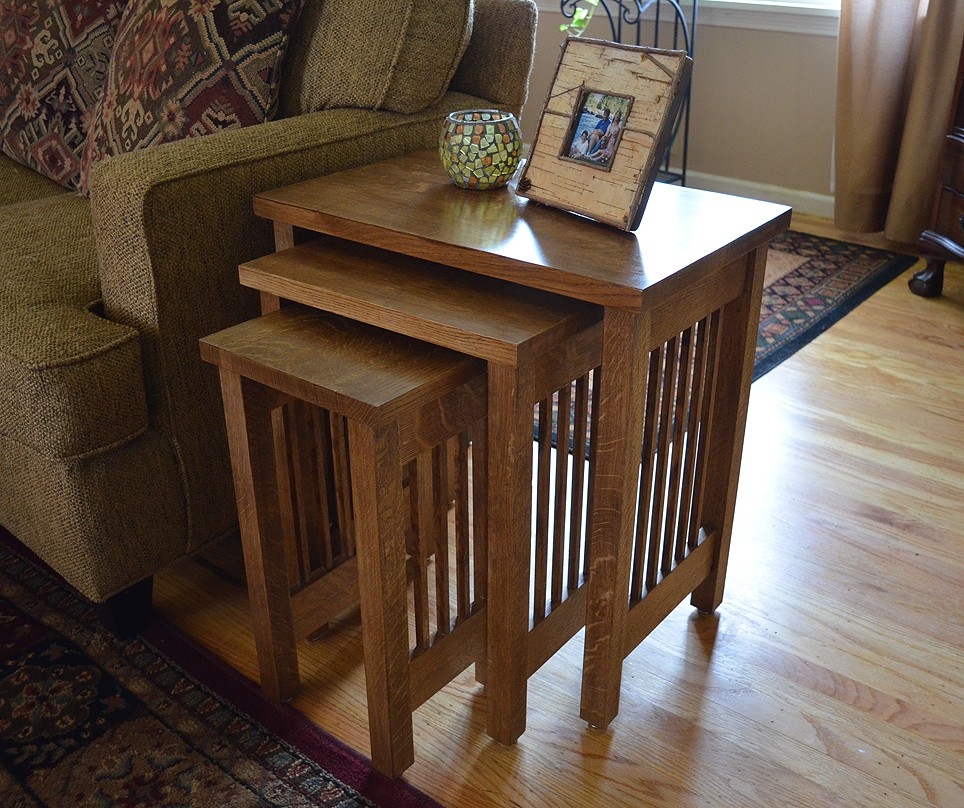
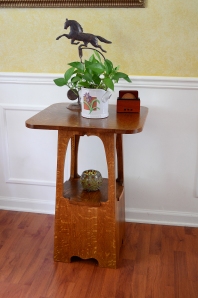
Mission Nesting Tables

$550

Mission style nesting tables. All quarter-sawn white oak.

All table tops are 1″ thick solid quarter-sawn white oak.

Largest table is 2′ tall; top measures 1’11” x 1′ 3″
Mid table is 1′ 10″ tall; top measures 1′ 1″ x 1′ 4″
Small table is 1′ 8″ tall; top measures 10″ x 11″

 
1 Comment

Posted by on November 26, 2012 in Furniture


Tags: , , , ,

My Advantage Over Retail

It’s hard to find an advantage over mass retailers of furniture; after all, they have floor space, traffic, advertising budgets and sales people. Me? I’m just me, with a website, and venues like CustomMade.com. If anything, I’m severely disadvantaged – or am I?

Actually, I have some advantages over mass retailers.

• Made to order: Perhaps my biggest advantage. When a consumer walks into a store, they look around for something that appeals to them. Many times, they won’t find that. With wooden furniture, that may be the wrong color, wrong height, wrong wood, and so on. I can usually accommodate any requested changes. With the big-box places, they may be able to change a color or wood, but never a mechanical change like an extra drawer – or no drawer. What I’ve also discovered is a distinct emotional advantage – the desire to love what I make for them. When a customer places an order, I often hear comments like “I’m so excited to see it!”, or once they get it, “I really love it!”. When a customer from a big-box store gets a piece home, it’s usually a pretty bland emotional response. Think about it – how excited were you to have purchased a piece from a store that is turned out by the thousands (if not hundreds of thousands), and someone else can have too? A distinct advantage I have is the customer wants to love what I make for them. They will even overlook issues to do that. And it makes sense; what would be more thrilling to you – something you bought off the shelf, or something someone handmade just for you?

• Relationship. I can establish a personal relationship with the customer that the big guys can only dream of having, which translates into more sales – not only repeat sales, but word-of-mouth sales. The only big company I can think of with such customer loyalty and excitement is Apple. Who gets excited about Ashley Furniture, Raymour and Flanigan, or other such big retailers? In fact, it’s almost a necessary evil to go furniture shopping (as it is with car buying).

• Nimble. It takes the big guys months – if not a year or more – to add or change a product or product line. For me, it can be days, or maybe a few weeks. Big ships take a wide swath to turn, but little runabouts like me change course quickly, adapting to new ideas or trends as needed.

• Multi-faceted. A large furniture store usually doesn’t have that large of a genre variety – they will have contemporary, country, and maybe some bad mission or period furniture – all home or home office stuff. I not only do that, but can jump into liturgical (furnishings for churches) pieces, custom cabinets – even toys.

• Product Quality. Unquestionably, my greatest advantage, which is value, really. I’m sorry, but big store furniture is generally crap – with the exceptions of Stickley and perhaps Bassett. All the other stuff is poorly made, poorly finished “furniture”. The worst being the finish of this stuff. When you can scrap off the color off a piece with your fingernail, that’s a crappy finish. When an ad circular for the big box stores describe a piece as having a “cherry finish” or the color is “cherry” what they are doing is using a little psychological trick – you hear the word “cherry” and your mind just associates the piece as being made of cherry.

• Made locally. Of all residential wood furniture sold in the United States, only about 31% is U.S.-made; most of the other product is made in Asia. Most furniture manufacturers and companies we think of as quintessentially American are making their furniture overseas (for example, Bassett, Broyhill, Lane, Lazy Boy, Ethan Allan, Thomasville, Pennsylvania House, Drexel, American Drew, Stanley and others). Over the last 30 years, tens of thousands of jobs for highly skilled furniture makers have been moved overseas, as so called “American furniture companies” have moved their manufacturing operations to China, Vietnam and other third world countries. When you buy locally – or even in the US – you help out fellow Americans. Not only myself, but my family, the places I purchase my wood, and the money I spend from my profits.

I have some advantages over retail they can never match; in educating consumers about the furniture of today, I can increase my sales, and give the consumer value for the furniture money.

 
1 Comment

Posted by on November 22, 2012 in BlogNotes


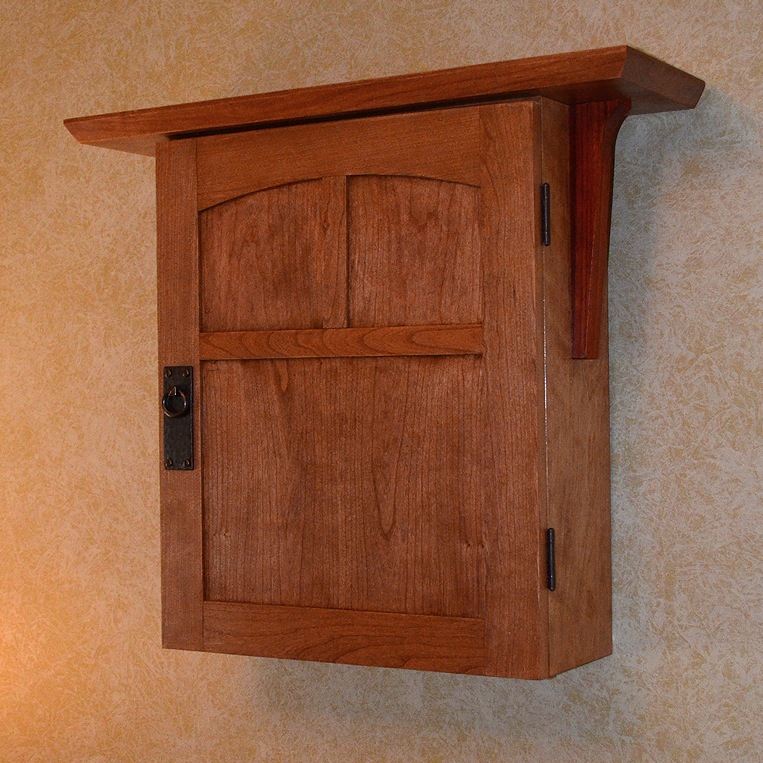
Craftsman Medicine Cabinet

craftsman medicine cabinet

$425


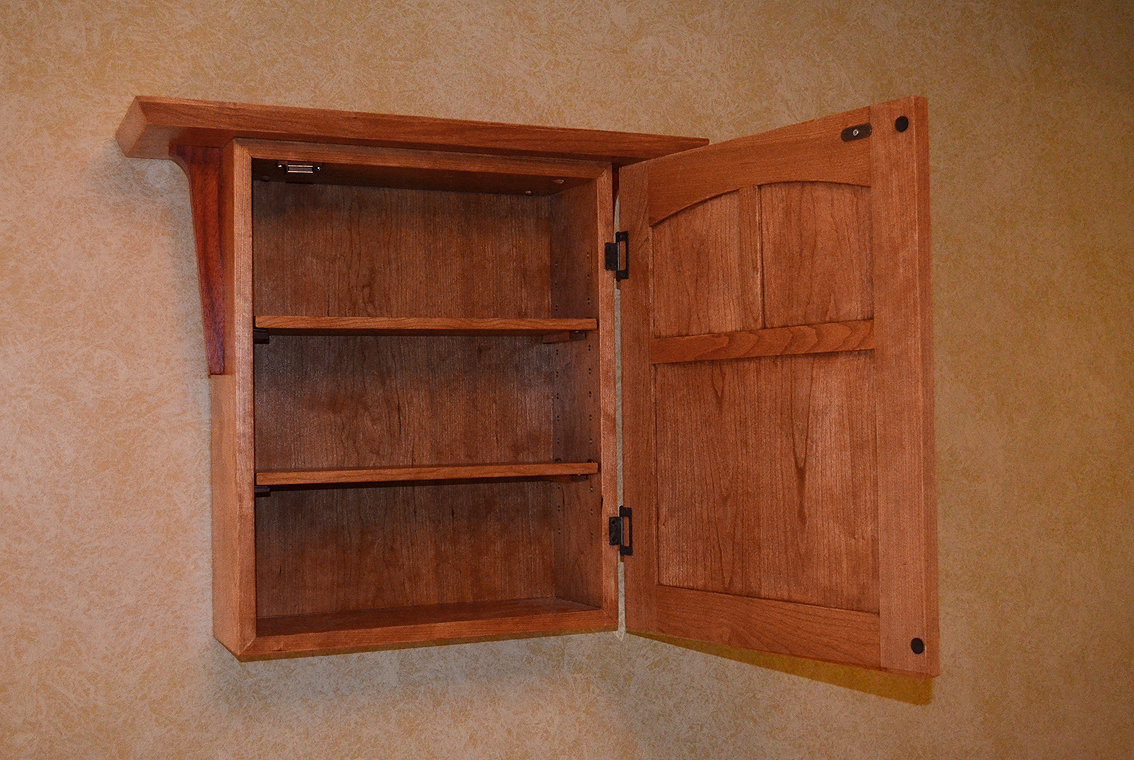
Craftsman (or Mission, Arts and Crafts) style medicine cabinet. Features a beautiful panel door with arched top.

Approximately 20″ high, by 6 inches deep, by 18 inches wide (the top is 2′ wide).

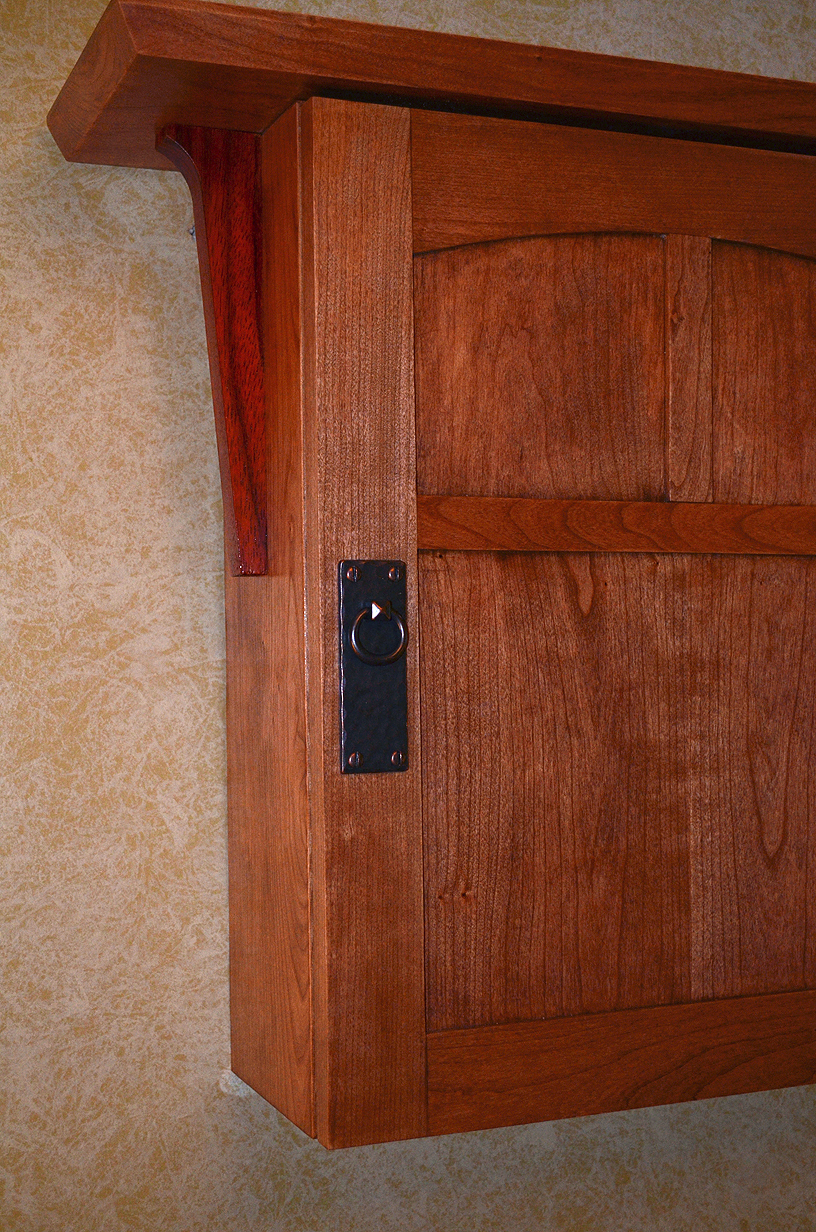
All cherry; the corbels under the top are paduak.

Comes with an easy-to-install hanger, which I’ll partially install for you. Includes two shelves, and ring pull hardware.

Cherry, when it is freshly planed, is a very pale salmon color. After about a year of being exposed to air and sunlight, it will reach a final color, the warm orange-brown cherry we love.

So then, I can leave it that normal color, and let it darken down over time, and just apply a top coat of shellac and wax, or, I can stain it for you a LIGHT cherry color, to give it some color. Keep in mind though, with the latter option, the final color will be darker than if you let it color itself over time. Personally, I would let it darken over time by itself for a perfect finish.

PLEASE NOTE: In these photos, the stain is more orangey than it really is; in reality, it is the warm brown-orange of traditional cherry.


Leave a comment

Posted by on September 29, 2012 in Furniture


Woodworking Apps – a Review

Smartphones – how handy are these things? Not only can you listen to music, take decent photos, have a GPS, a phone, text and play games, but you can also find them very handy in the shop.

In this installment of ShopNotes, I’ll review several of them, and give you the real-world lowdown on the good, the bad and the ugly. This is by no means a comprehensive review of all the apps out there, but ones that I have used. Read the rest of this entry »

 
3 Comments

Posted by on September 13, 2012 in BlogNotes


Tags:

Is it legal to sell pieces you made from purchased plans? You’ll be surprised.

You want to build and sell pieces of furniture or other wood projects, and you want to use plans you bought over the internet, from such venues as Fine Wood Working, Wood Magazine, or Plans Now – but is that legal? Isn’t there a copyright issue? The answer will surprise you.

Read the rest of this entry »

 
2 Comments

Posted by on September 6, 2012 in BlogNotes


Tags: ,

Shipping: The Problem Child of Woodworking

Shipping. It’s the part of selling my pieces that I hate the most. Forget marketing, working on the website, finding customers – it’s shipping that is the biggest pain. For one thing, it gets in the way of a sale – people might be ok paying $1000 for that table, but $300 to ship it? It can be a deal breaker, and I don’t blame them. Then they worry if it will get there ok. Having said that, some can argue the type of person willing to pay that much for a side table doesn’t really fret over the shipping cost.

So, if you pass that hurdle, then there is the problem of – actually shipping it. My smaller items, like clocks, aren’t so bad; but tables? OMG! It’s like another project all by itself. You have to find a cardboard box of the right size (unless you have to use a crate), then find stuff to put in it to keep it from being damaged, i.e., packing peanuts. Then you have to attach cloths or pads in strategic places on the piece to prevent damage. The last big piece I shipped – my Limbert side table – I was able to ship in a thick cardboard box, yet had to make a 4-way “strut” to keep the box from collapsing in the middle. Thankfully, it got there unscathed.

Ok, enough crabbing about shipping; here’s the upside.

Thanks to the Internet, i have a worldwide audience for my pieces, and a very lost cost way of getting my “catalog” out there. And thanks to FedEx, in my opinion, the best shipping outfit, I get my piece there in good condition, on time, and at a fairly decent price.

So while shipping, the problem child, will never turn 18 and move out, I can deal with it.

 
Leave a comment

Posted by on September 6, 2012 in BlogNotes


Tags:

Pricing Questions

In talking with potential customers, I often encounter the same conncerns or questions about the products and pricing. I thought I’d share those, along with answers….

• Wow. It seems like your furniture costs a lot! I can get a table like you have at Target for 1/4 the price you’re asking!

You’re right, I’m sure you can. You can get furniture you have to put together yourself, made out of :

“An environmentally friendly material called “engineered wood,” a combination of high quality hard wood and soft wood materials which are residuals of other lumber processes. These materials are bonded together with a synthetic resin, then applied to high heat and pressure.”

In other words, shredded wood lumber companies didn’t want, held together with a resin, which won’t hold screws, and the “finish” is paper laminate. Really? Is that what “furniture” is made of now? The designs are ok (at best), but doors fit poorly, the “finish” is easily marred and not repairable, and the piece is not strong. Water will damage it, easily. Handles or pulls will come off, as they are only plastic. They are one-size-fits-all furniture; no way to customize it, should you want to refinish it, order it a bit taller or shorter, and so on.

I know, I have purchased some before! Now before you have a heart attack, let me explain – this was when I was first married, when I wasn’t even into woodworking; we were young and needed some cheap furniture, somewhere to put our clothes. Since then, I’ve learned a lot about furniture and what passes off as furniture.

• Ok, so I’ll skip the put together yourself stuff. Still, I can get a table from a national chain like Ashley’s (no relation), IKEA, Raymour & Flanigan, or places like that. They are at least half your price!

They are, again you’re right. I’ll shock you again, I’ve bought from Raymour & Flanigan! Now, at this point, I was into woodworking, but certainly not into upholstered goods, like a couch. That’s just not my thing (yet). So, my wife picked out a love seat and sofa recliners, at a price of about $1500 (about 5 years ago), for our family room. After about 3 years of use, the one side of the couch where people usually sit is more deeper than the other side, and the arms at either end have some give to them. When you flip the couch over to vacuum behind it, you can see the frame twist. The upholstery itself has held up ok. It’ll have to be replaced in probably another 2 years.

When we finally replaced our living room furniture, and this time we got the good stuff – and there is good stuff out there in national stores. We bought Bassett. Specifically, a couch, love seat, and two upholstered recliner chairs; about $7000. That’s quite a lot, huh? It’s not because we are rich, we certainly aren’t; but this time, I did my homework, and found out which furniture is made like I would make it – built to last, and attractive. Even I was happy with the construction upon delivery. I expect it to last us 15 years, and even then, just the upholstery will need to be replaced, the mechanics should be fine.

• I see your point; you have to pay a lot of money to get quality furniture – but I can’t afford that! 

Actually, I’d argue it’s a false economy to keep buying furniture that damages easily, you’re not satisfied with nor proud of, time after time. Unfortunately in America, we’ve thrown craftsmanship out the window in favor of cheaper, but a looks-kinda-good mentality. Reminds me of Chrysler products – the look stylish, but won’t last, and have poor workmanship. A Mercedes looks great, and will last. Would you rather pay more for the Mercedes, drive it for much longer, and have a better experience, or take the Chrysler to the shop often, and be uncomfortable, or at least not thrilled with, the car?

• Again, why is your stuff so much? There’s not that much wood in it!
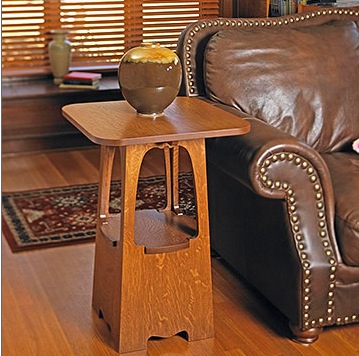
 Limbert tableIt’s not about the wood – though that plays a part. It’s about the time and craftsmanship that goes into each piece. The pieces I make aren’t made in the thousands,  nor the dozens, not even it pairs – all are made individually. Each has it’s own personality, it’s own feel. I don’t let it ship until I’m happy with it, late or not. I just don’t feel right any other way. Let me give you a little idea about what goes into making, say, my Craftsman Style Table:

  1. Going to the lumber yard, evaluating and selecting lumber, and hauling it home: 1 hour
  2. Breaking down the lumber and milling it into the close dimensions I’ll be using: 1 hour.
  3. Cutting the wood to gross final dimensions for all the pieces: 1/2 hour.
  4. Gluing up all four sides, the top and the shelf: 1 hour.
  5. Waiting for the glue to dry, cutting a few of the other small supporting pieces: 3 hours.
  6. Unclamping the pieces, hand planing them to flatness: 1 hour
  7. Cutting the pieces to final sizes, including tapered bevels: 1/2 hour
  8. Cutting out the large holes and bottom curls in the sides with a jigsaw and router: 1 hour.
  9. Sanding and chiseling those cut holes to perfection: 2 hours
  10. Cutting the shelf and top to final dimensions: 1/2 hour.
  11. Dry assembling and fixing any issues: 1/2 hour
  12. Sanding the entire project to perfection: 1 hour.
  13. Reassemble the bottom portion, glue up: 1 hour.
  14. Wait for glue to dry, sand mating corners to perfection, reexamine for other issues and fix: 3 hours
  15. Final fit the cleats that hold the top to the base, and install: 1/2 hour.
  16. Assembly complete; start finishing.
  17. Reexamine the table for any surface scratches; sand out; look for any other issues: 1 hour.
  18. Make up a custom dye, test on scrap piece for right color and density, test different number of coats to apply; wait to dry: 2 hours
  19. Apply dye to entire project, wait to dry, apply at least one more application: 2 hours
  20. Apply 3 coats of matte polyurethane, wait to dry between each coat, lightly sand and then remove sanding dust between coats: 3 hours
  21. Final inspection and sanding; 2 coats of wax: 1 hour
  22. Make a crate to ship the piece, pack and pad the piece: 2 hours
  23. Deliver to post office or carrier, 1 hour.

Total time: about 30 hours. And that’s not including the time put into marketing, photography, making special jigs and so on. The wood for that piece is about $150. The price I’m asking for it is $875; shipping is $100, but that’s barely enough. That’s $725 for profit, roughly, which is $24 per hour, assuming everything goes right, and I don’t make any costly mistakes.

If you’d like to compare prices, you can do so:

  1. MFDA, $1450
  2. Voorhees, $1800
  3. The Craftsman Touch, $2200
 
2 Comments

Posted by on September 6, 2012 in BlogNotes, Pricing Questions


Charles Limbert – My New Inspiration

Craftsman style tableYou’ve heard the name “Stickley” in regards to mission style furniture; but you probably never heard of Charles Limbert – yet in my opinion, Limbert’s contribution to the Mission or Craftsman style is every bit as important as Stickley’s.

Limbert took what Stickley did – the hard, straight right angles and softened them, without diminishing the angularity that defines the Mission style.

Here’s more on Limbert from the Arts and Crafts Society.

Charles P. Limbert was born in Lyonsville, Pennsylvania in 1854 and died at his home outside Grand Rapids, Michigan in 1923.

Influenced by the heavily Dutch population of the Grand Rapids area, Limbert started designing and building “Dutch Arts and Crafts” style furniture and lighting at his Grand Rapids factory in 1902. He always used the phrase “Arts and Crafts,” and never the word “mission” to describe his furniture. He was a student of European furniture designs, acknowledging the influence of the German and Austrian Secessionists on his work. British (particularly Charles Rennie MacKintosh), Japanese, and American Prairie School influences are also evident in Limbert forms. Limbert visited Europe on more than one occasion, and studied examples of Dutch peasant furniture.

Limbert claimed that the original Spanish Mission Style was derived from Dutch furniture designs. He employed a designer of Austrian background named William Gohlke. Paul Horti, famous for Shop of the Crafters designs, also designed some furniture for Limbert. Of all American Arts and Crafts furniture makers, Limbert was perhaps the best known for his use of decorative cutouts, including squares, spades, hearts, etc. While Arts and Crafts enthusiasts may not find all Limbert designs aesthetically pleasing, the good designs are very good.

He emphasized high quality in materials and joinery techniques, but his line was diverse enough to include outdoor furniture in the Arts and Crafts style. Like Gustav Stickley, Limbert also produced a short-lived line of inlaid furniture and, like Stickley’s, the line was not a commercial success. That the Charles P. Limbert Company stayed in business during and after WWI is a tribute to the appeal and success of its products with consumers. Limbert’s furniture was also chosen to outfit the Old Faithful Inn at Yellowstone National Park in 1906.

Charles was the son of a furniture dealer and cabinet maker, Levi H. Limbert. He first joined the furniture industry as a salesman, and in that capacity he was highly regarded. In 1894 he started a Grand Rapids, Michigan manufactory making chairs, all the while continuing to act as a sales agent for other furniture makers. He is recognized for having popularized the rustic furniture of Old Hickory of Martinsville, Indiana.

In 1906, he opened a factory in Holland, Michigan where he produced furniture until 1922 when ill health prompted him to sell off his interest in the company. Limbert said that he wanted a more healthy and productive location for his workers. The Holland factory was a scenic site with indoor and outdoor recreational facilities for the workforce. It was also accessible by interurban trolley line from Grand Rapids.

Limbert’s furniture has justly seen a reawakening of interest in the current Arts and Crafts Revival.

 
Leave a comment

Posted by on June 17, 2012 in BlogNotes, The Craftsman Style


Tags:

SketchUp: Worth Learning

Sketchup is a free drafting program from Google. They created it to be used to generate 3D buildings for their Google Maps feature. Woodworkers use it to make plans with.

Problem is, it has pretty steep learning curve. I gave it up twice. I know other guys that have tried it as well, and just gave up. I couldn’t blame them. However, I did go back to it, and forced myself to learn it, and a book called Google Sketchup for Dummies, by Aidan Chopra, helped out a lot. He also has YouTube videos too which are very helpful.

So why even bother using SU (Shorthand for Sketchup)? Why not just use paper and pencil, the old school way?

Well, obviously, there is a lot less erasing, lol. Besides that, I like the way I can play with pieces so easily in virtual space. I can concentrate on the look first, and the technical later. I can go into joints, and see how they’ll work; I can see if certain woods would go together nicely, or not, because I can give each piece a texture – make this piece oak, that piece cherry. I get exact measurements, whether it be degrees of an arc, or length of a piece. I can “explode” the drawing, like they do in magazines, so I can get a better idea visually of how everything goes together, and can even print out the pieces and their measurements for use in the shop. Also, you can print the pieces at 100% size, so you can use them as a template for a complex shape. I hear you can even make SU generate a cutting diagram on a virtual board!

In short, there is a LOT that SU can do for you, the woodworker, and you really should take the time to learn it, if you ever think you’re going to want to make up your own plans someday.

 
Leave a comment

Posted by on June 15, 2012 in BlogNotes


Tags:

Mistakes are Just Forced Opportunities

I make mistakes in the wood shop – too many.

Sometimes “mistakes” are just forced opportunities.

One example was Edison’s attempt to make a telegraphic-telephonic repeating and recording device, it didn’t work, but when somebody gave it a spin it sounded like human speech. Edison started from that chance observation and developed the phonograph.

It can also happen in the shop.


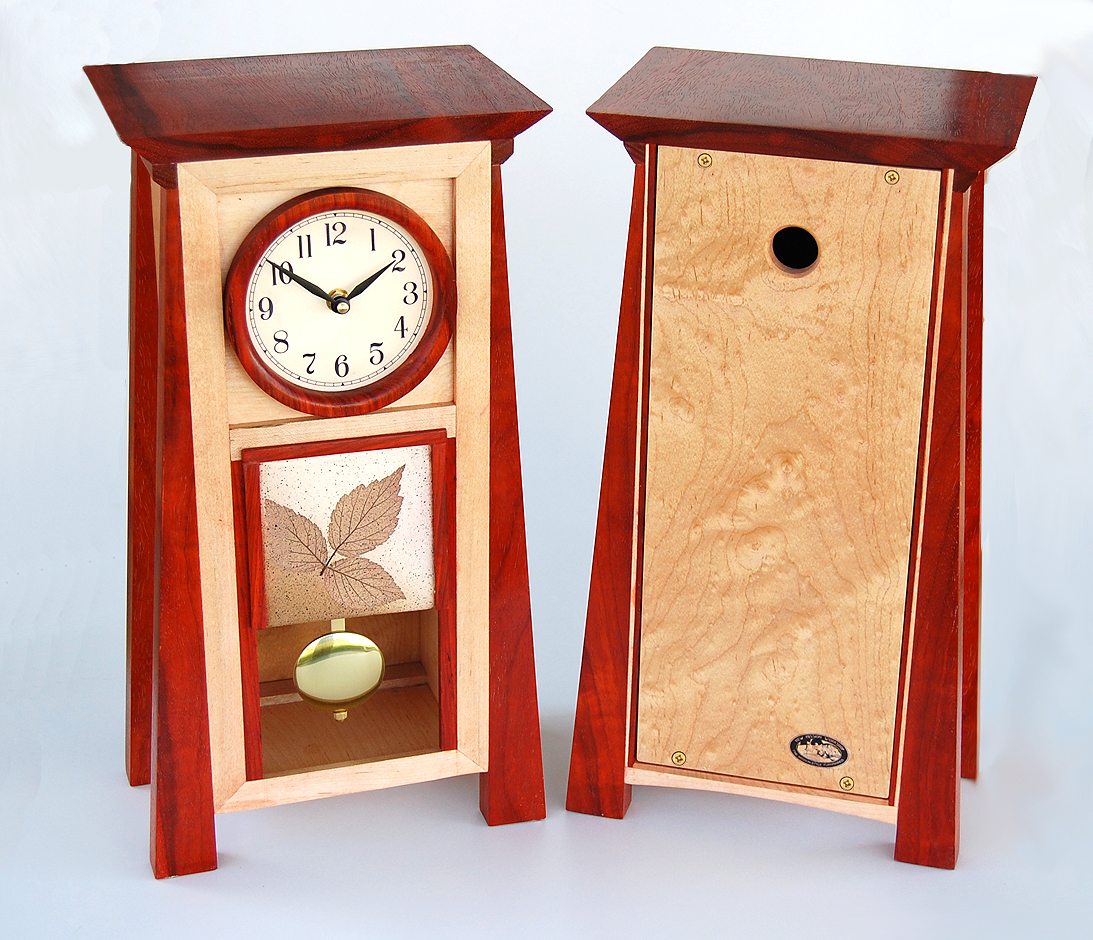
For example, I was making a mantle clock, about 16″ high, shown here:

Keene Mantle Clock

I had to rabbet the sides of the clock to recive the back door. I did this on my router table. It was a 1/4” rabbett on a 1/2” stock. Of course, I set up and tested the rabbett on a scrap piece of stock. Worked fine. Right depth and so on. My mistake was, I did the whole depth in one pass on the real pieces. I should have done an 1/8” at a time, instead of the whole 1/4”. What ended up happening was, the bit crept out of the collet on the router, cutting deeper than I wanted. Ugh!

The only option was to throw out 4 nice pieces of maple ( I was making two clocks), or get creative.

What I ended up doing was re-rabbetting all four pieces to an equal depth, and then gluing in a strip of paduak to bring the rabbett back up to the originally intended 1/4” depth. The result was a more visually appealing ( I think) back of these pieces.

Obviously, sometimes mistakes can’t be fixed; if you needed a piece to be 8” long, and you cut it to 7”, you probably can’t just glue it back on and hope no one will notice. Some mistakes are final.

But other times, if you get creative, you can turn mistakes into a positive.

 
6 Comments

Posted by on June 15, 2012 in BlogNotes


Tags: