RSS

Author Archives: pashley1916

Craft Shows: What Sells? Part 3

craft showEveryone interested at doing a craft show to earn some cash wants to know – what to sell? What should I make that will sell well, and make a good profit for myself?

That’s the $64,000 question.

In fact, how much would you pay me to tell you exactly what to make? LOL. I can’t do that, but I think I can provide some guidelines, based on what I’ve observed.

• Uniqueness. Buying pressure is put on the consumer when they find something at a retail venue that they haven’t seen elsewhere. Their thought is, “This is great! I haven’t seen this anywhere else, I should get it.” You shouldn’t be selling something 25 other vendors are. Keep in mind, that quality and/or style figures into uniqueness as well. If my cutting boards are uniquely styled, and/or have better quality than the other vendors, that’s helpful.

• A low price point. I hope this is obvious. Are more people likely to shell out $20 or $50? Having a high-end item, in the $300 range might be a good idea, to get people to come in, and the small $20-ish item lets them spend without sweating about it.

• Geared toward impulsive women. Women are about 80% of the customers, in my experience. They like to buy decorative items, especially for the outdoors. Why outdoors, especially? My theory is, they don’t get to garden stores that often, where outdoor decorations (bird baths, wind chimes, brass sprinklers) are usually sold – so they don’t have the chance to buy those type of items. In contrast, they can buy indoor decorative items in any chain store – Target, Wal-Mart, etc.

• An item that can be easily carried. Would you want to lug around something heavy for the rest of the show, or run it back to the car? That can be a deal breaker for some. Sometimes, I have seen where a large heavy item, such as stones that are etched, or rustic baskets – all that are heavy – can be left in a “corral” the vendor provides with a paid for tag on it, so the customer can pick it up on their way out. Alternately, you can pay some kid to be your mover and take it out to the car for the customer.

• Food. Hey, everybody needs it. Probably not an option with LJs, but perhaps the wives might be interested. The hassle is, (at least here in NY) you have to have certification to sell food products. That probably involves a kitchen inspection, and all kinds of insane rules for the kitchen – such as shelves have to be at least 12” off the floor. I don’t know if there is a huge hassle for small time craft show people – you’ll have to look into it. There is a vendor I see at every show – and whom I buy from every time – Nunda (“nun-day”) Mustard. They sell flavored mustard. Here’s their website. Awesome product – unique, easy to carry, cheap – about $4.75 a jar. They always have samples too, which is a MUST.

•A “green” item”. “Green” – that is, environmentally friendly – items are a feel-good product. When you buy, why not buy green, and help “save” the environment. You can make it a point that all your products are from reclaimed wood, for example.

To the element of uniqueness and craftsmanship, I have seen variations of the following phrase constantly in articles over the years;

“Two paths to success – do something uncommon or do something common, yet uncommonly well”
• Traffic usually follows a pattern in these places; being the first vendor with cutting boards (jewelry, garden items, etc) is definitely a plus – someone might buy from you before buying from the guy with similar stuff another 100 feet down the path.
• Displays are everything. You don’t need to have a broadway show, but have an attractive setting.
• Interact with customers, just say “hello” even. I’ve seen a lot of sellers just sitting there doing something else – reading a paper, playing with their Blackberry, etc. Talking to passersby gets their attention, they might see something they want on your table.
• Dress the part. Selling wood stuff? How about wearing a nice white shirt, with the sleeves rolled up, and a new leather apron – act and look the part. No NASCAR shirts, or one that says “BUSH SUCKS.” Play the role. YOU can be part of the product, in a sense.
• Business cards! Several bunches all over your table. You might be busy talking at length with a customer, and I wanted to ask a question. Oh, you have a business card with your email on it – I’ll contact you that way.
• Consider putting out something that catches people’s eyes – food. Candies, crackers, whatever. Will draw attention to your table.
• Give your customer every opportunity to buy from you; don’t make barriers to being able to take their credit card, check or cash.
• Trick #1 If you have some good friends, here might be a trick worth trying: have them crowd around your booth. Nothing draws a crowd like…a crowd. People think something is going on, something to look at, so they come over too.
• Trick #2. Have your friends walk around the show with some of your product, like they just bought it. If people see a few people with that product, they are going to think it’s worth buying, for some reason or other, and will look for your product. It’s a group-think mentality. What would you think if you saw 5 people, here and there, with a wrought iron Sheppard’s crook to hang plants from? It’s got to be a hot item!

 
Leave a comment

Posted by on May 31, 2012 in BlogNotes


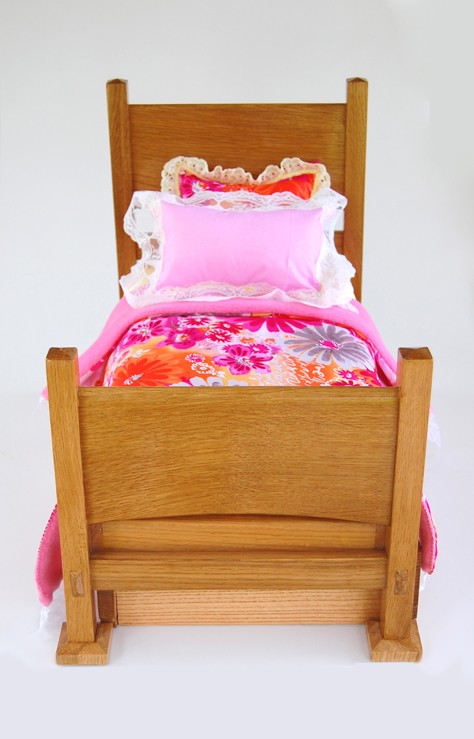
Mission-style Doll Trundle Bed

Doll trundle bed

$195


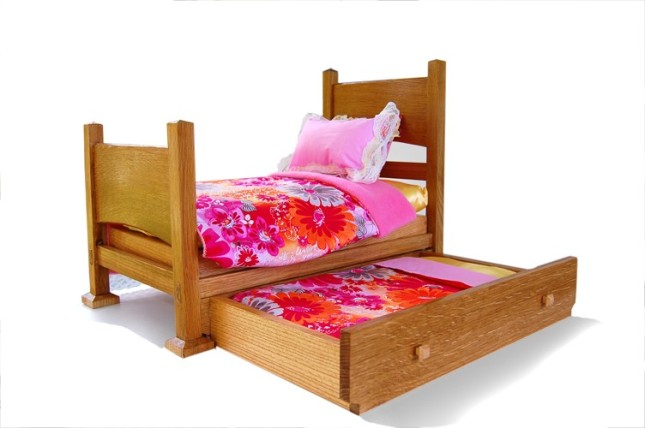
This wonderful little trundle bed would be a wonderful gift for that special little girl in your life. Made of all quarter-sawn white oak, with cherry trundle pulls, this bed will last generations.

The bed features through tenons, a “box spring” and mattress (just a mattress for the trundle), pretty bed dressings and two pillows. The trundle is not mounted on slides; it simply freely pulls from under the bed, which is the usual case in a real trundle bed.

The bed measures approx. 21″L x 15″H x 12″ wide, not including the trundle.

This bed fits the American Girl doll perfectly – it’s the doll in these photos.

 
Leave a comment

Posted by on May 23, 2012 in BlogNotes


Tags: , ,

Craft Shows: What Sells? Part 2

I’ve been to many craft shows, and have observed things that sell consistently well. Usually, they are decorative items, geared towards women. Here are a few of those items; maybe they’ll give you some ideas, or you can just start making these things and selling it yourself!

Plant hanger

Wrought iron plant hangers.

Self-standing, and ones you attach to a house or pole. They don’t take all that long to make, and the materials aren’t that much. If you’re a woodworker, metal work might not interest you, but they do sell well.


Rustic Plantar

Rustic style planters.

Planters are always a good seller, especially rustic types, like this one. Some old barn wood, birch bark, twigs, and you’re good to go. Figure about $40 for this one.

Alpha Letters


Photo Letters

If you’re a decent photographer, and you have a decent-size town, and no competition, sell these. Even if you aren’t a good photographer, become one! These have huge mark up and little work put into them. The basic deal is, you go around your town, find objects that make up the entire alphabet, take a quality photo of it, make 100 copies (about $10), and tape them to the back of a matted frame, and sell it. Check out a gal that does them in my area; she gets $55 for three letters, matted and framed. She must get the frames and mattes in bulk, probably $8 for a three-letter frame. I’ve actually had a booth, right next to her, and seen her rake in the cash. Women love it because it’s decorative, it’s different, and it can be customized. You can put in a name, “love”, catch phrase, or whatever. If she wasn’t around, I’d be doing this.

cutting board

Cutting boards

The woodworking staple in every craft show. They do sell – fairly well – but make sure you have a good quality, unique product, and make sure you are near the entrance to the venue, because you want to get the sale before the other guy a ways down the line in the venue. That’s generally a good rule for any product you sell in a craft show – be the first one people come to, because once they buy one, it’s doubtful they’ll buy a second, so be the first guy.

Jelly


Mustards/Sauces/Jellies

Food always seems to go well at craft fairs. I’m not talking about hot dog vendors and such, but prepared, jarred condiments, such as mustards and jellies. A local brand, Nunda Mustard always sells well at craft shows; they sell for $5 each, and I always grab a jar or two. Specialty jellies, like mint or jalepeno seem to do well too. I don’t know how much trouble you have to go thru to sell food products, in terms of the the state health laws, I’m sure it depends on the state. Something to think about if you’re a foodie! By the way, you must provide a sample at a show; you can’t expect people to buy food without tasting it in this situation.

soap

Handmade Soaps

We all know the ladies like things that smell nice, and handmade soaps do, and usually do well at shows; I don’t believe there is any state health law issues to deal with, since this isn’t a consumable product (but I could be wrong). At about $5 – $6 each, I’m guessing the mark-up is quite good. I like them myself, and I’m a guy, so I gotta believe women really like them!

Well, there is some ideas for you, or your wife. I hope they work out for you!

 
1 Comment

Posted by on February 11, 2012 in BlogNotes


Tags:

Craft Shows: What Sells? Part 1

Craft showSo, what exactly does sell at craft shows? Woodworkers want to know. Why do some people make out like bandits, while others languish?
I’ve made several observations – and found actual data – to help answer that question, and I’ll share it here.

What sells depends on variables: What kind of show it is (juried, non-juried), the venue (inner city, or Beverly Hills?), the clientele (woman, men, kids, mixed?), season, position in the venue, and more.

The first variable to consider, in my opinion, is the clientele. Typically, this is women, and as we all know, they love to shop. Generally, they are bringing some cash along, and are open to, if not outright seeking to, part with their money. Men, when they are toted along, don’t tend to spend much, in my observations, the exception being at food stands, where everyone spends. Therefore, your target should be women, unless you want to try to nail down the man niche.

You tend to see a LOT of jewelry made by women for women; easily 30% of the show; usually young to middle aged women buy here. Then there is the crocheted/knitted items – dish cloths, doll cloths, doilies, and so on. This is also probably another 30% of the show. Older ladies tend to buy this stuff; it’s not expensive. Food vendors usually tend to make out well at shows, both the ready-made food carts, and packaged products, such as mustards and jellies. Decorative items, both inside and for the garden, lawn or home tend to do well, if they are nice. Following up the rear are woodworking items, like kids toys, cutting boards, birdhouses, etc.

It’s worth noting that people aren’t looking to spend a lot at these shows – though there are regional shows in which high-end pieces are sold, such as a $5,000 Queen Anne Highboy. For the most part, things under $30 are the lion’s share of sales. Also, things that are easier to carry around a show don’t hurt – though I have seen good-sized rustic planters purchased then set aside for the customer to pick up on exiting.

In future blog postings, I’ll be exploring WHAT to sell, and how to sell it.

 
Leave a comment

Posted by on February 8, 2012 in BlogNotes


Tags: , ,

Dimensioning Your Wood; Let Someone Else?

drum sanderA great part of our time spent in the shop is for breaking down lumber into final (or near final) sizes. For the woodworker trying to make some production time ( as opposed to the occasional weekend project), time is money, and also frustration (sometimes) and even danger. So why not pay someone to take that on?

Let me get a little more specific. Let’s say you’re going to do a craft or trade show – you need to get quite a bit of product ready, in other words. Or maybe your’re making several of the same pieces for Christmas presents. Either way, you’ve got a lot of breaking down of lumber to do. Depending on your lumber supplier, you’re either going to get rough sawn wood, with no side planed, or wood fully dimensioned – like you would see at Home Depot or Lowes. With the latter, all you have to do is cut it to a final dimension, and you’re ready to go. With the former, you have to surface plane a wide flat side, then joint the two edges, finishing it to final thickness at a planer. That’s a lot of sawdust, and also more opportunities to get injured, nick a blade, or generally add wear and tear to your equipment. Not only that, but also the fairly large amount of time that takes.

More and more, I’m having my lumber guy finally dimension my stock. Obviously, I can’t have him cut final size lengths and widths (usually), but I can have him plane and joint all four sides; he’s got the larger jointer and planer to handle up to 8″ wide lumber, and I don’t. His thickness planer has a three-sided spherical head, which means I sand a LOT less. When I get back to the shop, I just have to rip and cut, and I’m ready. I can concentrate more on the quality of fitting the pieces together, and the finish, rather than breaking down lumber.

And if you think it’s expensive, it’s really not – check with your lumber supplier; it’s usually so much per foot, but I find it well worth the price.

Now I understand that some guys like to do all the dimensioning and breaking down themselves, because the need certain parts of the board, have an odd size, or whatever. But generally speaking, out sourcing this part of the process is well worth the money.

 
Leave a comment

Posted by on January 30, 2012 in BlogNotes


Tags:

Turning mistakes into opportunities.

We’ve all done it; cut some piece in our project the wrong size, accidentally gouged it, or otherwise messed it up. Usually, we just move on to another piece, discarding that one.

Sometimes “mistakes” can actually be opportunities in disguise.

One example was Edison’s attempt to make a telegraphic-telephonic repeating and recording device, it didn’t work, but when somebody gave it a spin it sounded like human speech. Edison started from that chance observation and developed the phonograph.

It can also happen in the shop.

While developing my clock Keene, I turned would could have been a disaster into a chance to get really creative.

Take a look at this picture – especially the shot of the back of the clock:

craftsman clocks

Look at the sides of the door. You’ll see the back door, which is quilted maple, a thin sliver of Paduak, and then more maple. It’s a nice visual interest; otherwise, it would have been just plain maple on maple, up to the Paduak leg.

It wasn’t intended that way! Here’s the back-story:

I had to rabbet the sides of the clock to recive the back door. I did this on my router table. It was a 1/4” rabbett on a 1/2” stock. Of course, I set up and tested the rabbett on a scrap piece of stock. Worked fine. Right depth and so on. My mistake was, I did the whole depth in one pass on the real pieces. I should have done an 1/8” at a time, instead of the whole 1/4”. What ended up happening was, the bit crept out of the collet on the router, cutting deeper than I wanted. Ugh!

The only option was to throw out 4 nice pieces of maple ( I was making two clocks), or get creative.

What I ended up doing was re-rabbetting all four pieces to an equal depth, and then gluing in a strip of paduak to bring the rabbett back up to the originally intended 1/4” depth, to properly receive the door. The result was a more visually appealing ( I think) back of these pieces.

Obviously, sometimes mistakes can’t be fixed; if you needed a piece to be 8” long, and you cut it to 7”, you probably can’t just glue it back on and hope no one will notice. Some mistakes are final.

But other times, if you get creative, you can turn mistakes into a positive.

 
Leave a comment

Posted by on January 28, 2012 in BlogNotes


Tags:

Planning on Plans?

woodworking plansSo I’m considering selling my plans on line now. I’ve been asked for them several times. However, being the over-achiever perfectionist I am, I want to do it really well. Not just an exploded drawing with some measurements, but actual directions on what to make first, tricks for doing it right, and so on. I want the experience to be so good, the customer will come back.

It’s also worth pointing out that the time I put into a plan, which would be considerable, would generate residual sales for years. Compare that to building one clock, for instance, then selling it, building another, selling that one, and so on. Instead, I build once, sell many times, like authors or recording artists. I like that.

 
Leave a comment

Posted by on January 28, 2012 in BlogNotes


Craftsman Mirror

Craftsman Mirror$299

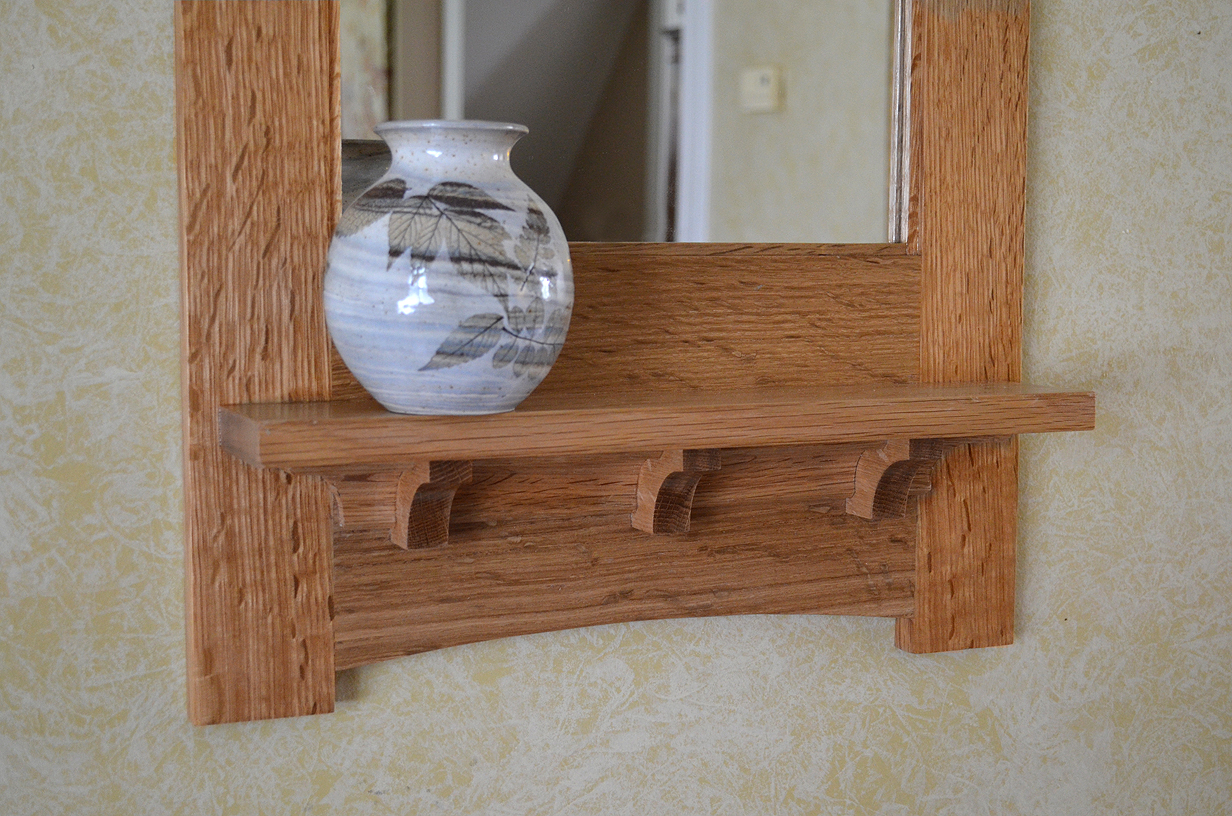
Handcrafted Craftsman (or Mission) style mirror. Beautiful, unique piece you’ll love. A narrow shelf supported by corbels offers a place to display small items, and the decorative cove moldings between the corbels and on the top really give the mirror a more refined look. The interior frame muntins at the top of the mirror break up the otherwise one piece look of the mirror. All solid wood, no veneer. Mortise and tenon joinery make it bullet-proof.

Comes with special mounting bracket to ensure a level and solid mount. White oak. Finished in shellac.

35″ High x 20″ Wide x 3 3/4″ Deep
Approximately 15 pounds.

Mirror shelf

 
Leave a comment

Posted by on January 24, 2012 in Furniture


Tags: , ,

The Speculator Craftsman Lamp

craftsman lamp$175


“Love this style and hope to see you offer a hanging lamp. Well made and sturdy. – Heidi

The New Mission Workshop’s wonderful new addition, Speculator, exhibits exactly what the shop’s goal has been all along – to update the traditional mission style of past generations with a lighter styling that is often desired today.

Made of solid cherry, Speculator has the traditional mission lines, but lighter wood – unstained cherry – and leaves out the heavier look of the traditional mission style. Please note that cherry will darken over time to a warm reddish-brown, especially when in sunlight.

Materials: Cherry

Dimensions: Approximately 25″ high x 12″ deep/wide.

Finish: Clear shellac, finished with three coats of Briwax.

Warranty: 1 year

NOTE: The lampshade shown is for demonstration purposes only; the lamp does not come with a shade.

craftsman lamp
Price: $175

 
Leave a comment

Posted by on January 24, 2012 in Furniture


Tags:

Fairmont Unity Urn

craftsman$275


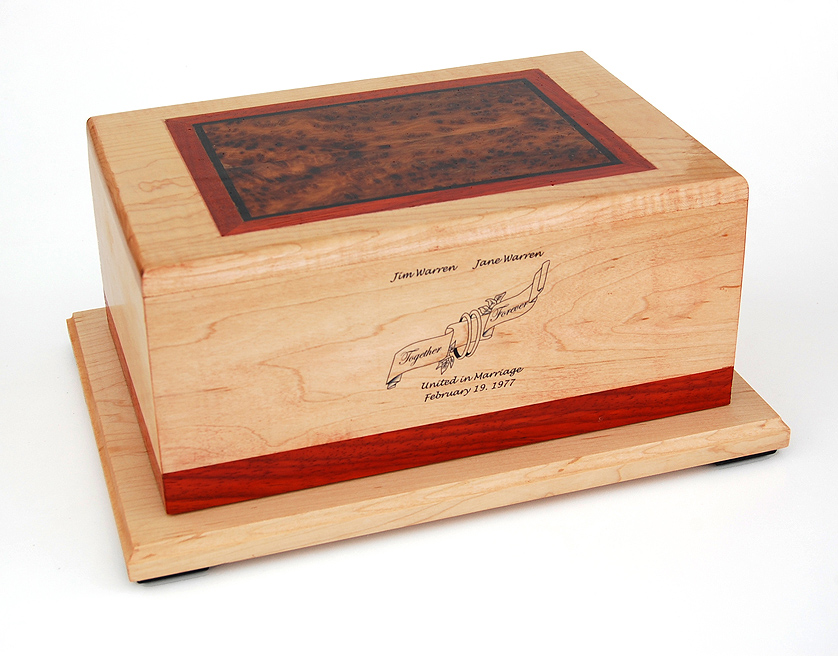
A unity (or “companion”) urn is meant for two people. The cremains of the (typically married) couple each has their own compartment. Companion urns are commonly used for couples that make the decision to be together after passing. Many families will choose to purchase a companion urn before both couples have passed. This personal decision is made so when the couples pass they can remain close.

The materials used in the Fairmont consist of maple, for the main body and bottom plate; quilted (or “tiger”) maple for the top, which is inlaid in either Thuya or Amboyna burl (depending upon availability; both look very similar), ebony and paduak (the reddish color wood).

The approximate size of the Fairmont is 14 inches long by 11 inches wide (measuring the bottom plate) and 6 inches high. The main body, top and bottom plate of the Fairmont is crafted in 3/4″ thick maple. The “feet” on the bottom plate are ebony blocks, with softened edges – what is often called “pillowing”, because the end result is a block of wood that resembles a pillow in shape.mission

The exact size of the internal (and thus external) dimensions of this urn is dependent upon the size of the two people whose remains will reside in each chamber; the urn in this picture specifically was for a man of 200 pounds or less and a woman 160 pounds or less. The internal dimensions are calculated by simply converting the person’s weight to cubic inches – a 200 pound man would require 200 cubic inches of space. I will over build the dimensions by about 10 percent for safety. Typically, urns are accessed through the bottom – and that is the case here, with 4 wood screws of moderate size.

For no extra charge, a crest decal is provided, with the appropriate details customized. The decal is sprayed over in several coats of shellac (as is the whole urn), for protection. For an extra fee, a laser engraving can be done – please ask me for details.

Materials: Maple, quilted maple, paduak, Thuya or Amboyna burl, ebony.

Dimensions: Approximately 6″ high x 10″ wide x 14″ long.

Finish: Clear shellac, finished with three coats of Briwax.

 
9 Comments

Posted by on January 24, 2012 in Liturgical


Tags: , ,